
- 3
- Salt forms covered here: TFA, acetate and chloride
- 10 mM
- HCl strength a 2025 study found best for swapping out TFA
- 6
- PubMed papers cited on this page
The short answer
What is the difference between a TFA salt and an acetate salt?
A peptide in a vial is not always alone. It usually carries a small partner molecule, called a counterion. On a TFA salt, the partner is trifluoroacetate. On an acetate salt, it is acetate. A chloride form uses chloride.
The peptide chain is the same in each case. Only the partner changes. Most lab-made peptides come out of the factory as TFA salts, because of how they are made and cleaned [1].
This page explains the label in plain words. It covers where the partner comes from, how labs swap it, and what to look for on a listing.
Terms
What is a salt form, in plain words?
A peptide chain often carries positive charges along its length. Those charges attract negative partner ions, the way a magnet draws a paperclip. Together they make a salt.
The partner ion is not part of the chain. It rides along in the powder. When the label says TFA salt, it names that partner.
Counterion
The small negative ion that sits next to the peptide chain.
TFA
Short for trifluoroacetate. It comes from an acid used during making and cleaning.
Acetate
The partner ion from acetic acid, the acid in vinegar.
Chloride
The partner ion from hydrochloric acid, written HCl.
Where it comes from
Why do most research peptides arrive as TFA salts?
Most lab-made peptides are built on a solid-phase method. In the last steps, the chain is cut loose from its carrier and then cleaned. Both steps use trifluoroacetic acid, called TFA. That is why the finished peptide mostly carries TFA as its partner [1].
A 2025 paper says the same thing in a different way. It notes that this acid is used to cut the chain free and as a cleaning aid, so the peptides end up as TFA salts [2].

- 01
Build
The chain is built one amino acid at a time on a solid carrier.
- 02
Cut
A strong acid, TFA, cuts the finished chain loose.
- 03
Clean
TFA is also used in the liquid that carries the peptide through the cleaning column.
- 04
Dry
The cleaned peptide is freeze-dried, and most of the TFA partner stays with it.
Swapping
Can a TFA salt be changed to acetate or chloride?
Yes. Labs swap the partner ion on purpose. A 2008 paper tested three ways to swap TFA on one eight-residue peptide. Two of them swapped it partly or almost fully for a weaker acid such as acetic acid. The third used a basic solution and removed the TFA fully [1].
The older method is to freeze-dry the peptide again and again with a strong acid. The same paper warns that this means working at a very acidic pH, which can damage some peptides [1].
A 2012 paper tested freeze-drying from hydrochloric acid and from acetic acid. It found that both removed the TFA to satisfactory levels [3].
The partner ion can also get in the way of the lab's own checks. The 2008 paper reports that TFA interferes with infrared measurements of the peptide. That is one reason labs swap it [1].
A 2025 paper swapped TFA for chloride by freeze-drying in HCl at different strengths. It found that 10 mM HCl was the best condition, and it saw no change in purity at any strength tested [2].
Three papers on swapping the partner ion
| Paper | What the team did | What it reported |
|---|---|---|
| Roux, 2008 | Tried three swap methods on one eight-residue peptide | Two gave partial to almost full swaps; the basic-solution method removed TFA fully |
| Mrozik, 2012 | Freeze-dried peptides from HCl and from acetic acid | Both removed TFA to satisfactory levels |
| Erckes, 2025 | Freeze-dried peptides in several HCl strengths | 10 mM HCl was best; purity was unchanged |
Does it matter
Does the salt form change a lab result?
It can. In the 2025 paper, the team ran a membrane test with synthetic peptides. They found that the passing rate depended on the peptide sequence and on its salt form. The authors say counterion content should be measured and stated when a peptide is used in an assay [2].
It does not always change the result. A 2025 team compared TFA and HCl forms of one gel-forming peptide. For the properties they tested, they found no significant difference between the two forms [6].
One paper adds a note on habits. It says most early research work is centered on TFA salts, even though other salt forms are common later on [6]. So a TFA label is common. It is a fact to read on the label.
So the honest answer is that it depends on the peptide and the test. No paper here says one salt form is better for every job.
Two papers, two answers
- Synthetic peptides in a membrane test
- Passing rate depended on sequence and salt form
- Authors urge measuring counterion content
- One gel-forming peptide
- TFA and HCl forms compared
- No significant difference in the properties tested
Checking
How do labs tell which salt is in the vial?
Labs measure the partner ions directly. A 2012 paper compared three methods on acetate, TFA and chloride. Ion chromatography gave the best results [3].
A 2004 paper built an ion chromatography method for leftover TFA. It could detect TFA below 90 ng/ml in the samples it tested, including a commercial peptide [4].
The 2025 paper used three ways to measure leftover TFA: infrared, fluorine NMR and HPLC with a light-scattering detector. It validated all three [2]. You do not need to know how each works. It is enough to know that a lab can put a number on it.
Another paper looked at how the partner ion can be lost. Acetate and TFA can evaporate during freeze-drying. In one study of a single peptide, the loss of these partners shifted the acidity of the mixed solution and the peptide clumped [5].
Your checklist
What should you look for on a listing?
A salt form is a small line on a label, but it is a real part of what sits in the vial. Start with the plain question: which salt form is this? A listing or certificate should name it. If it says nothing, ask.
Next, ask whether the salt form stays the same from lot to lot. The papers above show that the partner ion can matter in a test, so a change between lots is worth knowing about.
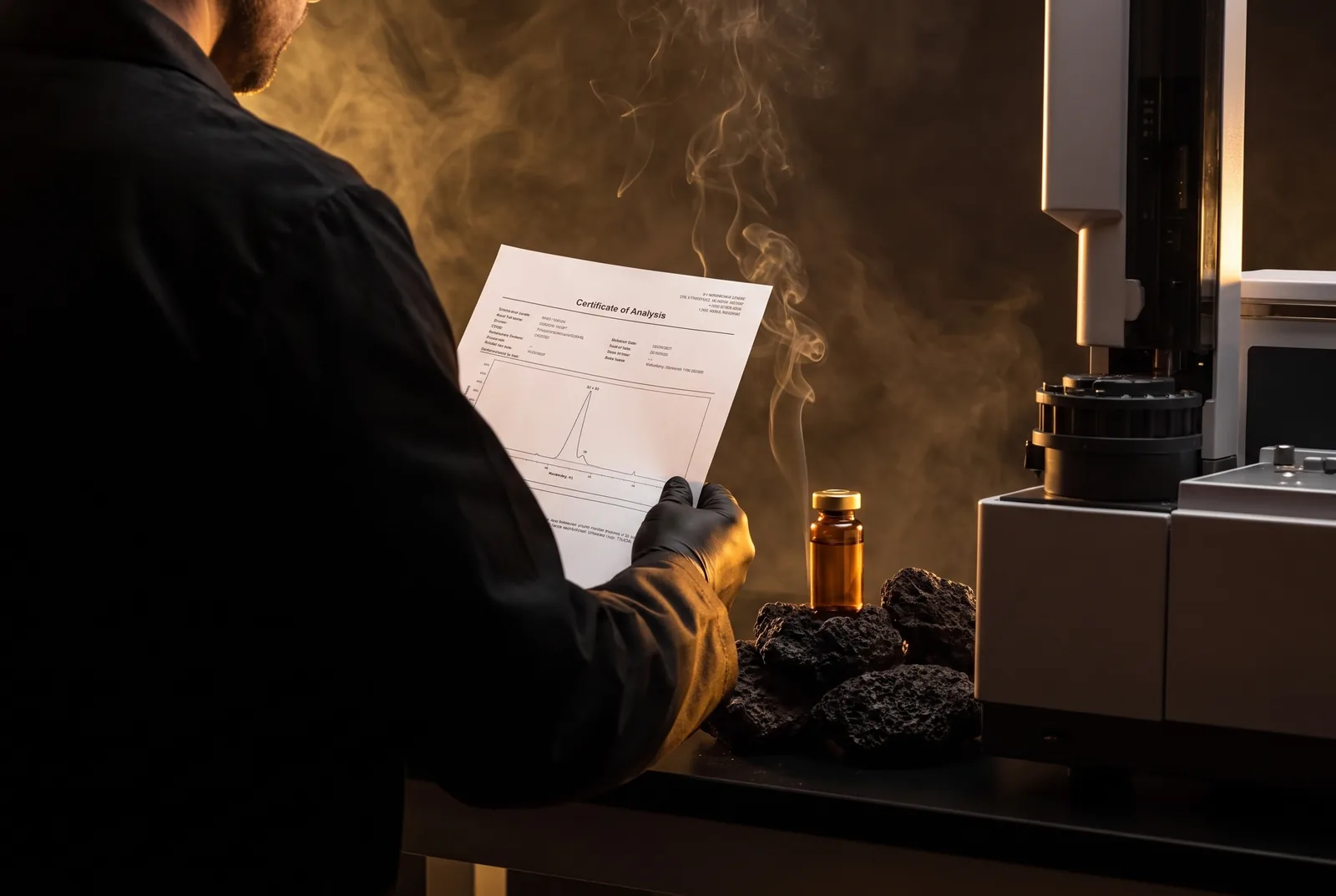
Then read the certificate. The certificate of analysis page shows the report for each product. Check that it names the salt form. The supplier checklist covers the other paperwork to ask for, and the glossary defines the terms.
- Which salt form is this product: TFA, acetate or chloride?
- Does the certificate say how much partner ion is in the powder?
- Is the salt form the same in every lot?
- Which lab measured it, and with what method?
Questions
Common questions
Is acetate better than TFA?
No paper here says so. One 2025 study found a difference between salt forms in a membrane test. Another found none for a gel-forming peptide. It depends on the peptide and the test.
Does the salt form change the peptide chain?
No. The chain is the same. Only the small partner ion beside it changes.
Can I tell the salt form by looking at the powder?
No. Labs measure it with instruments such as ion chromatography.
What is a counterion?
It is the small ion that pairs with the charged peptide chain to form a salt. TFA, acetate and chloride are common ones.