
How to read a certificate of analysis
A certificate of analysis is a lab test report, not a sales sheet. You can check four of its fields with no equipment at all, and those four are where most problems show up.
What a certificate is
A certificate of analysis records what an analytical laboratory measured on a sample of material. It names the lab, the method, the result and the date. Without those four, it is not a report.
That is the idea. It is also where most certificates in this market fall short. A PDF with a product name, a purity number, no lot, no date and no instrument output is a picture. It tells you nothing beyond the number printed on it.
The fields, and what each one means
- Product and sequence
- Name plus the one-letter or three-letter amino acid sequence. The sequence is what the mass gets checked against.
- Lot number
- Must match the number printed on the vial you are holding.
- Date of manufacture and date of analysis
- Analysis after manufacture. Both present.
- Purity by HPLC
- Reported as area percent at a stated wavelength, usually 214 nm.
- Identity
- How the lab confirmed the compound: retention time against a reference standard, or the predicted and measured mass, both printed.
- Net peptide content
- The fraction of the powder that is peptide rather than water and counterion.
- Water content
- Karl Fischer titration, reported as a percentage.
- Counterion
- Usually trifluoroacetate or acetate, with the percentage.
- Appearance
- White to off-white lyophilized powder or cake.
- Storage
- The condition the stated retest date assumes.
A certificate missing any of the first five is not a certificate.
The four checks anyone can run
- 01
Match the compound and the date
Check the compound and size on the certificate match what you are buying, and look at the test date. A certificate with no date, or for a different compound, is not a report on your material.
- 02
If mass is reported, add up the sequence and compare
Every amino acid has a known residue mass. Add them up, add 18.02 for the water at the ends, and you have the predicted mass. It should match the figure printed on the certificate, and the measured figure should sit within about one mass unit of it. Where identity is by retention time instead, check that a reference standard is named.
- 03
Look at the chromatogram, not the number
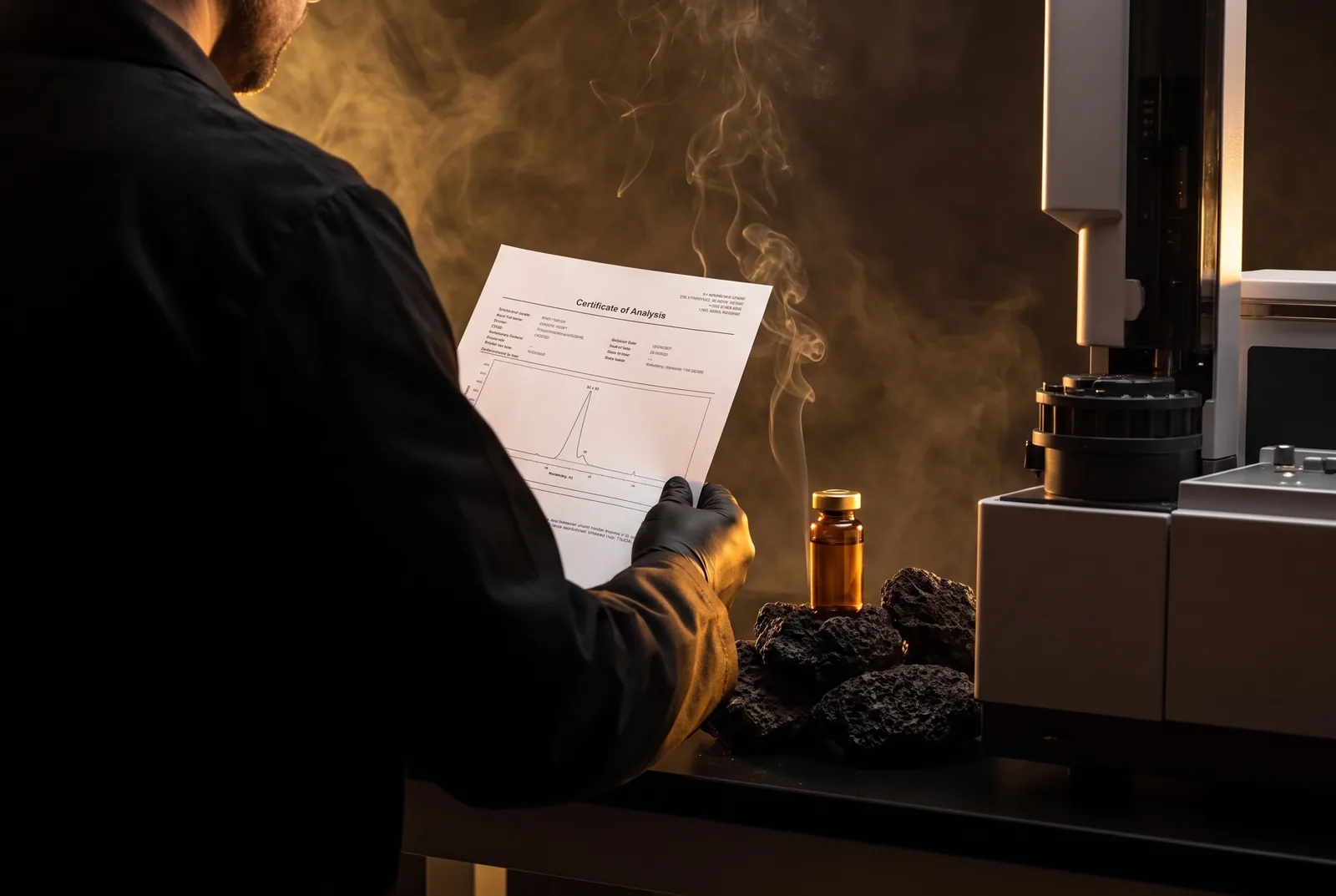
Purity is reported as a percentage, but the trace behind it is what tells you anything. A clean run has a flat baseline, one big peak and labeled axes. A cropped image with the axes cut off is hiding the baseline, and the baseline is where the impurities are.
- 04
Find the laboratory
A name, a report number and a contact. A certificate with no issuing laboratory on it was issued by whoever is selling you the material.
What a certificate cannot tell you
Purity by HPLC is a share, not a weight. It is the target peak as a share of everything the UV detector saw at that wavelength, and at 214 nm the detector is mostly seeing amide bonds. Anything in the vial that does not absorb there is invisible to the measurement: inorganic salts, most of the residual solvent, the counterion. Those show up in the weight of the powder and not in the purity figure, which is why net peptide content is a separate line.
The other thing it cannot tell you is whether the sequence is the one you wanted. Mass confirms the total. It does not confirm the order. Two peptides with the same amino acids in a different order weigh the same, and telling them apart takes peptide mapping or sequencing, which almost nobody in this market runs.
Questions
Common questions
What purity figure should a research peptide reach?
Solid-phase synthesis followed by preparative HPLC routinely reaches 98 percent or better, and most reputable suppliers set 98 percent as the floor. The number matters less than whether the chromatogram behind it is legible and whether the report names the lab and carries a report number you can check.
Why is purity reported at 214 nm rather than 280 nm?
214 nm is close to the absorbance maximum of the peptide bond itself, so every residue contributes. 280 nm relies on tryptophan, tyrosine and phenylalanine, so a sequence without aromatic residues barely registers. Purity at 214 nm is the general-purpose number.
Does a certificate expire?
The analysis does not, but the material it describes changes. A retest date states the point at which the supplier expects the stated specification to need re-confirming under the storage condition printed on the document. Stored differently, the date means nothing.
Can a certificate of analysis be faked?
Easily. The fields that are hardest to fake well are the ones worth checking: a legible chromatogram with its axes intact, a predicted mass that matches the printed sequence, and a named lab that answers the phone.
Cite as: SBz Industries research library, "How to read a certificate of analysis", https://www.sbzindustries.com/research/how-to-read-a-coa, updated 2026-09-11.
Keep reading
Related guides
Documentation
Every compound, its certificate published
We expect the checks on this page to be run on our own paperwork. The latest certificate for every compound is on its product page.