
- 60.1-80.9%
- Purity range of crude lecirelin batches in one studyMeasured by capillary electrophoresis
- 96.4-99.9%
- Purity range after HPLC purification, same studySame peptide, same lab method
- up to 11%
- Acetate counter-ion by mass in those batchesReported as a separate number from purity
The short answer
What does 99% pure mean on a label?
A label that says 99% pure usually reports one number from one test. The test is HPLC, a lab method that sorts a sample into its parts. The number says how much of what the instrument saw was the right peptide.
It does not say that 99% of the powder in the vial is the peptide. Those are two different questions. A label rarely tells you which one it answers.
This page covers where the number comes from, what it leaves out, and what to check on the certificate before you rely on it.
How the number is made
How does the lab get a purity number?
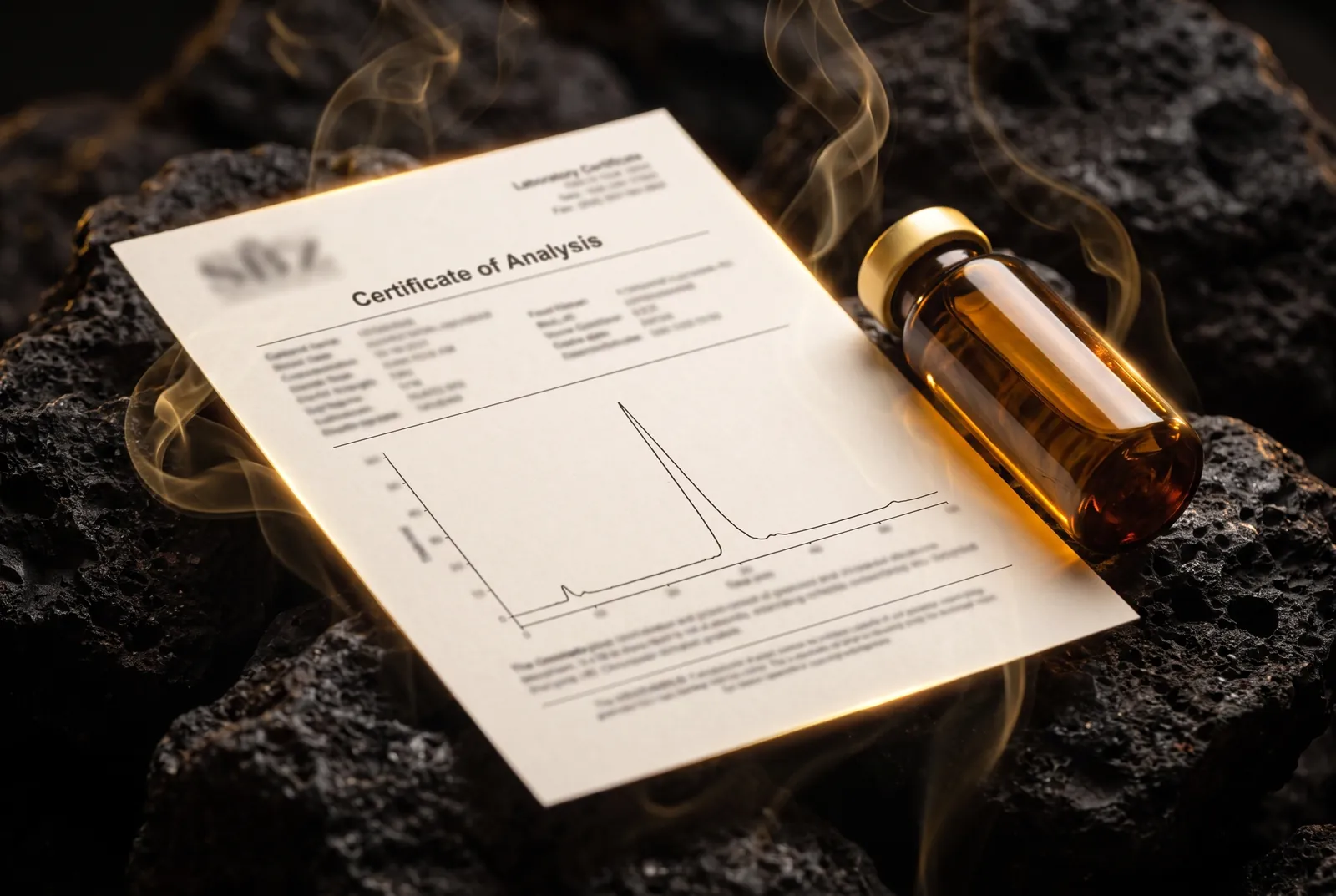
In HPLC, the lab dissolves a small sample and pushes it through a packed tube. Different molecules leave the tube at different times. A detector at the end reads how much ultraviolet light each one absorbs.
The software draws a chart with one peak for each part it sees. Purity is the area of the main peak divided by the area of all the peaks. For peptides, the detector reads the light absorbed by the peptide bond [1].
So 99% means the main peak made up 99% of the total peak area. That is a statement about the chart. This is why the method and its settings matter. Two labs can run the same sample and draw the line between peaks in different places.
- 01
Dissolve
The lab dissolves a small sample of the powder.
- 02
Separate
The sample runs through a column and splits into parts.
- 03
Detect
A UV detector records each part as a peak.
- 04
Calculate
Main peak area divided by total peak area gives the percentage.
What it leaves out
What does the number not tell you?
The method assumes that UV absorbance tracks mass. One analytical paper notes that this assumption means the result may be only semi-quantitative [1]. The percentage is a good guide. It is not an exact weight.
The chart also shows only what the detector can see. Take mirror-image forms of amino acids, called D-forms. They can come in with the starting materials or form during synthesis. Labs measure them with a separate chiral method [2].
- One percentage comes from one method.
- It describes the sample the lab tested.
- It is not the same as how much peptide is in the vial.
- Mirror-image forms may need a second test.
The other 1%
What is in the other 1%?
The leftover share is not random dirt. It is often peptides that are close cousins of the one you want. Some are missing an amino acid. Some have an extra one. Some have a small chemical change on one amino acid.
A study of thymalfasin materials shows how many there can be. The lab found 23 related impurities in one reference standard, including insertions, deletions, dimers and isomers [6]. A dimer is two peptide chains stuck together.
An HPLC chart can show these as small peaks next to the main one. A good certificate lets you see the chart, not only the final number. Small peaks you can see are easier to trust than a total you cannot check.
What else is in the vial
What else can be in the vial?
Many peptides are made with trifluoroacetic acid, or TFA. It is used to release the peptide from the resin and to purify it. Because of this, peptides are often obtained as TFA salts [3].
The acid that pairs with the peptide is called the counter-ion. Acetate is another common one. A lab method to measure both acetic acid and TFA in synthetic peptide samples was validated back in 1998 [4].
Peptide content asks how much of the powder, by mass, is the peptide. Labs measure it with methods such as amino acid analysis or elemental analysis. HPLC purity is then used as a correction for the impurities [1].
In a study of lecirelin batches, counter-ions made up anywhere from zero to about 11% of the mass, depending on the batch and the ion. Purity and counter-ion content were reported as two separate numbers [5].
Numbers that can appear on a certificate
| Number | The question it answers |
|---|---|
| HPLC purity | Of the parts the detector saw, what share is the main peptide? |
| Peptide content | How much of the powder, by mass, is the peptide itself? |
| Counter-ion content | How much of the powder is the acid paired with the peptide? |
| Identity by mass spectrometry | Is the main peak the compound on the label? |
Same number, different test
Can two vials both say 99% and differ?
Yes. The same number can come from different methods, different detector settings, or different lots. A figure with no method beside it is hard to compare. Ask for the chart, the method and the lot, and compare those.
The lecirelin study shows how much a number depends on the batch. Crude batches measured 60.1% to 80.9% pure. Batches that were HPLC purified measured 96.4% to 99.9%, by capillary electrophoresis [5]. The same peptide gave a very wide range.
What you are comparing
- A single percentage
- No method named
- No test date
- No lab named
- The percentage and the method
- The product name and sequence
- The lab that ran the test
- The test date
What to check
What should you check before you trust the number?
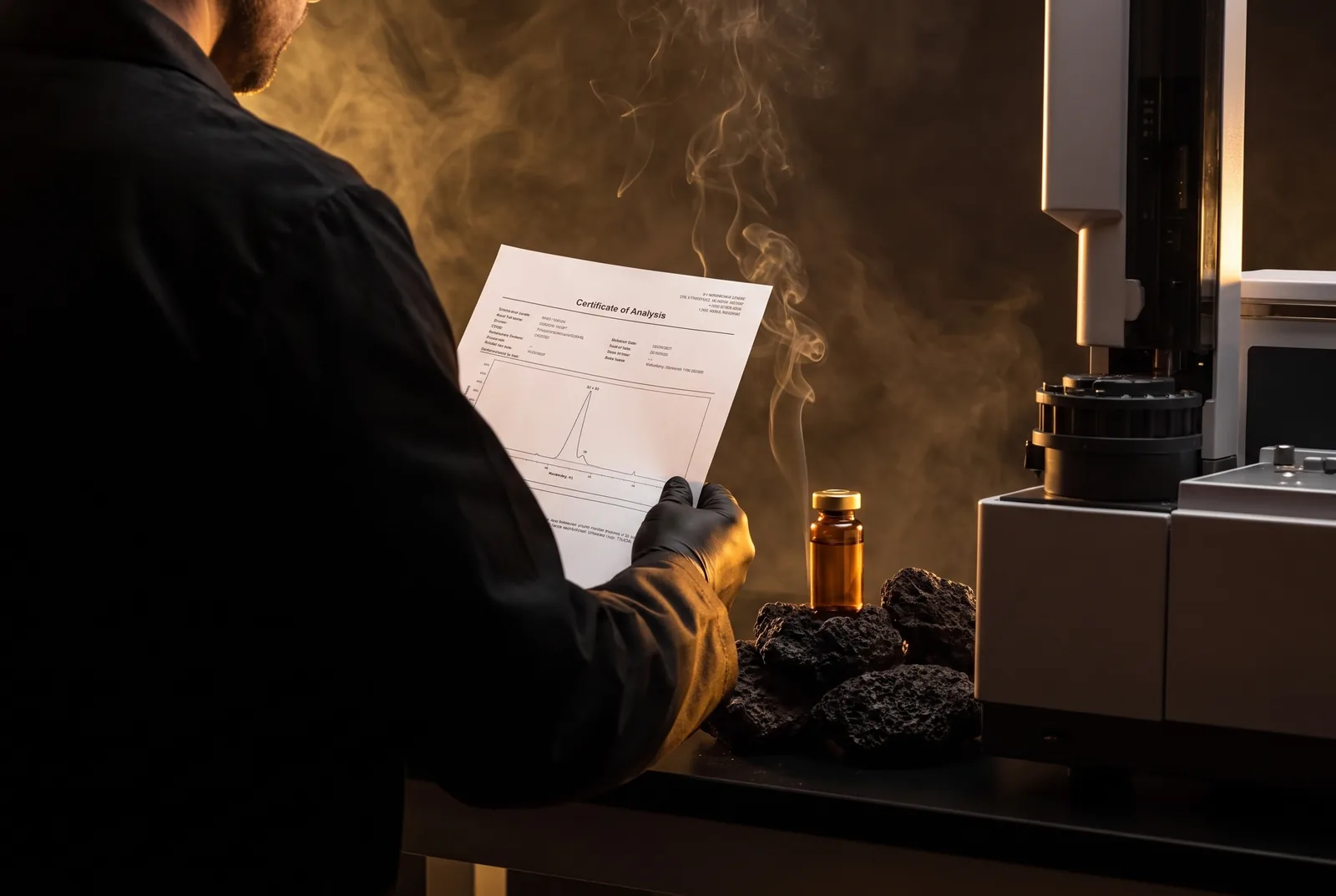
Start with the product's certificate. The certificate page shows how each one is laid out.
Then look for the lab, the method and the test date on the same page. Reference standards get their value by combining several methods, including NMR, mass spectrometry, HPLC and GC [7]. A single percentage is a thin record next to that. It tells you a result exists. It does not tell you how the lab got there.
Keep a copy of the certificate with your order, so any later question can be traced to one test.
Ask whether the number is purity, peptide content, or both. The supplier checklist and the testing standard cover what to ask. The glossary explains the terms, and the lab page names the lab.
Product match
It should match the number printed on your vial.
Method
HPLC, plus the detector wavelength.
Lab name
An independent lab, named on the page.
Purity and content
Two numbers. Ask for both if only one is shown.
Test date
So you know the result matches the product.
Questions
Common questions
Is 99% purity the same as 99% peptide?
No. Purity is a share of what the detector saw. Peptide content is a share of the whole powder by mass. They are separate numbers.
Why do peptides arrive as TFA salts?
TFA is used to make and purify many synthetic peptides. A certificate may list the counter-ion that came with the peptide.
Should a certificate name the method?
Yes. A percentage means little without the method, the lab and the test date beside it.
Can two labs report different numbers for one lot?
They can if the method or settings differ. That is why the method belongs on the certificate.