
- 37
- Amino acids in natural human amylin
- 3
- Amylin receptor types in one structure paper
- 2021
- Year the cagrilintide design paper appeared
The short answer
What are cagrilintide and eloralintide?
Cagrilintide and eloralintide are both lab-made versions of amylin. Amylin is a short natural peptide hormone. The pancreas makes it alongside insulin [5]. A made version with a changed sequence is called an analog.
The two are not the same compound. Cagrilintide came from Novo Nordisk, and a 2021 paper in the Journal of Medicinal Chemistry describes how it was built [1]. Eloralintide is newer. A 2026 review describes it as selective and long-acting [9].
This page explains what each one is, how they differ, and what to check on a label and a certificate. It does not cover what either one does in a body. Both are sold for laboratory research only.
Many readers land here from a search for one name and meet the other on the same shelf. A plain map of the two saves time before you compare vials. The sections below start with the natural hormone, then each analog, then the checks.
Starting point
What is amylin, and why change it?
Natural human amylin has 37 amino acids. Amino acids are the small building blocks that link into a peptide. Cells in the pancreas called islet beta cells store it with insulin and release it together with insulin [5].
Natural amylin has a problem for people who design peptides. It tends to clump into long, stringy fibrils. The Novo Nordisk team calls this a hallmark of the hormone and says it makes design work hard [1].
Pramlintide was the first analog of this kind. It was based on the structure of rat amylin, which does not clump [6]. It also has a short half-life, which means it does not last long in a sample [1].
Those two limits explain most of what came next. A 2026 review says recent design work built a second generation of analogs that do not clump and last longer [6]. Cagrilintide and eloralintide both belong to that group.
Cagrilintide
What is cagrilintide?
Cagrilintide is a lipidated, long-acting amylin analog. Lipidated means a lipid, which is a fatty chain, has been attached to the peptide. The Novo Nordisk authors describe it as stable [1].
Their paper also covers some of the structure-activity work behind the choice. Structure-activity work means making many close variants of a peptide and comparing them. Cagrilintide was the one picked from that set [1].
A fatty chain is one way to make a peptide last longer. A 2026 review lists lipidation and reversible albumin binding among the advances behind long-acting amylin analogs, cagrilintide among them [7]. Albumin is a common protein in blood.
The same review sorts these compounds by which receptors they reach. It places cagrilintide among the dual compounds, which reach both the amylin receptor and the calcitonin receptor [7] [6].
Analog
A made version of a natural peptide with a changed sequence.
Lipidated
A fatty chain is attached to the peptide to change how it behaves in a sample.
Albumin binding
The peptide binds albumin, a common blood protein.
Eloralintide
What is eloralintide?
Eloralintide is a newer long-acting amylin analog. A 2026 review calls it a selective compound, meaning it is aimed at the amylin receptor and not at several receptors at once [9]. Another 2026 review calls it mostly an AMY1R compound [8].
AMY1R is one of three amylin receptor types. The three types are named AMY1R, AMY2R and AMY3R [2]. So that wording tells you which receptor type the compound is described as reaching. It does not tell you how it was built.
The sources cited here give fewer design details for eloralintide than for cagrilintide. Their abstracts do not give its sequence. That matters at the shelf, because a label and certificate are then the main place to check what a vial is.
Fischer and Borner place eloralintide in the same family as cagrilintide, with lipidation and albumin binding behind the long-acting design. They add that the compounds differ in how long they last and in which receptors they reach [7].
Side by side
- Lipidated, long-acting amylin analog
- Design paper published in 2021
- Described as a dual amylin and calcitonin receptor compound
- Developed by Novo Nordisk
- Long-acting amylin analog
- Described in 2026 reviews
- Described as selective, mostly AMY1R
- No design paper in the sources cited here
Receptors
What do these compounds bind in the lab?
Amylin receptors are built from two parts. One part is the calcitonin receptor. The other is a helper protein called a RAMP. There are three RAMPs, which gives the three receptor types [2].
A 2022 paper in Science worked out the structures of these receptors with amylin attached, and with calcitonin from salmon and from humans attached. The amylin-bound structures looked alike across the receptor types. The calcitonin-bound ones looked different [2].
A 2024 study used cells to build amylin variants. It started from rat amylin and changed it by mutagenesis. It measured how tightly variants bound parts of the receptors, and how strongly three representative variants activated the human amylin and calcitonin receptors. It compared the results with pramlintide [4].
For a buyer the point is narrow. These papers explain how this peptide family is studied in cells and in structures. None of them tested a vial from any supplier.

How an amylin receptor is built
| Part | What it is |
|---|---|
| Calcitonin receptor | The shared base of every amylin receptor |
| RAMP | A helper protein, in three kinds |
| AMY1R, AMY2R, AMY3R | The three amylin receptor types |
Longer-lasting designs
Why do labs keep redesigning amylin?
Half-life is the time it takes for half of a compound to be gone from a sample. Pramlintide has a short one [1]. A 2022 Janssen paper put it at under 45 minutes in mice [3].
That paper tried a different fix than a fatty chain. The team swapped pramlintide's ring, which is held shut by a sulfur bond, for a ring held by a thioether link. The new ring let them attach pramlintide to an antibody. Two of those conjugates had half-lives of about two days in mice [3].
The point is that there is more than one route to a longer-lasting amylin analog. Cagrilintide uses a fatty chain. The Janssen work used an antibody. The 2026 reviews describe the field by how long each design lasts and which receptors it reaches [6] [7].
So when two vials carry different names, the sequence and the add-on can differ a lot. The label should name the exact compound.
- 2018
A review covers amylin as a 37-amino acid hormone.
- 2021
Novo Nordisk describes the design of cagrilintide.
- 2022
Receptor structures with amylin are reported. Janssen reports antibody-linked pramlintide.
- 2024
A cell study maps amylin variants against amylin and calcitonin receptors.
- 2026
Reviews group cagrilintide, eloralintide and other long-acting analogs.
At the shelf
What should you check on the label and the certificate?
Start with the name. Cagrilintide is not pramlintide. It is also not CagriSema. CagriSema is cagrilintide co-formulated with semaglutide, a second compound [6]. A label that says one name should match a certificate that says the same name.
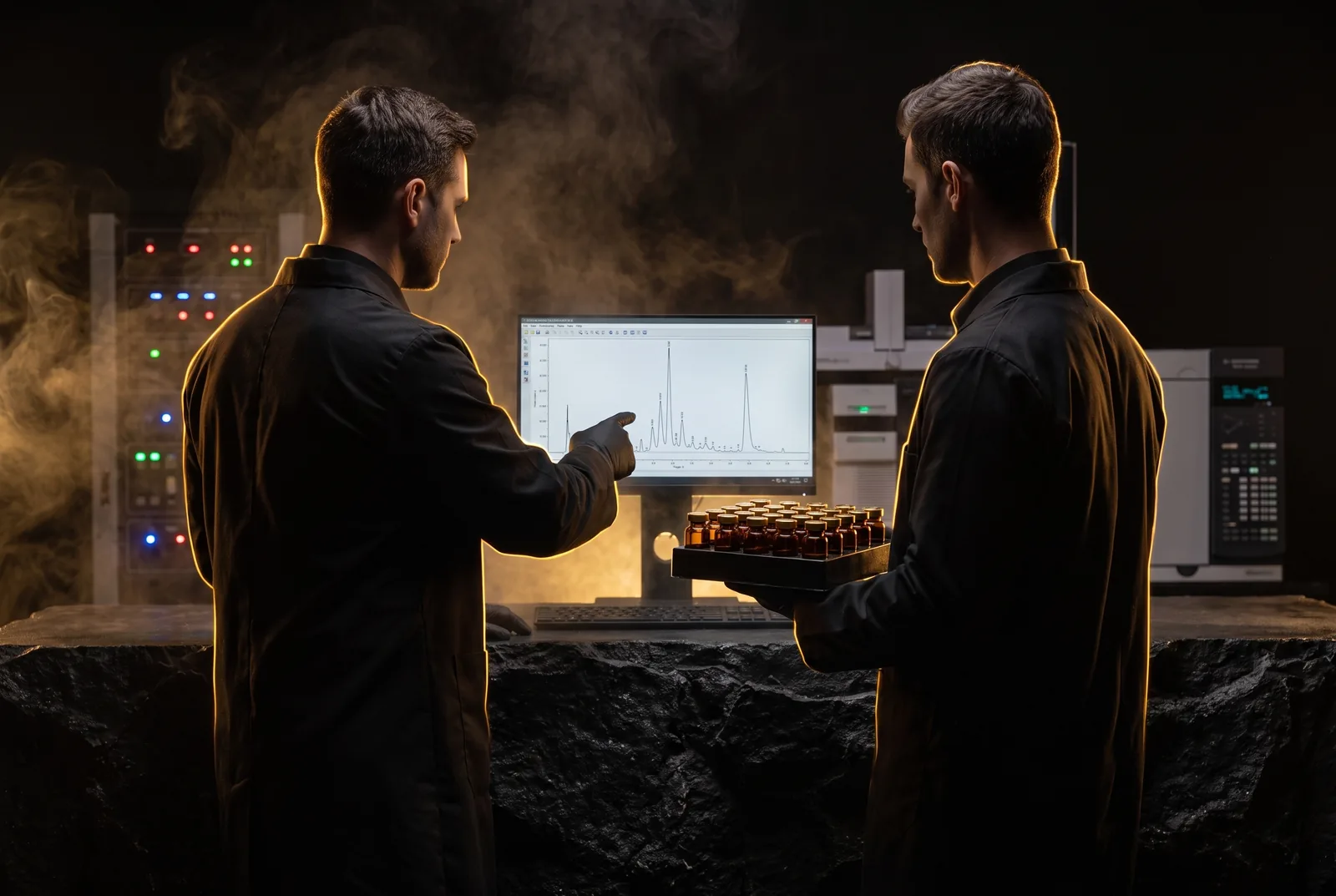
Next, look for a certificate for that exact product. A certificate of analysis is the lab report. It should say which compound was tested, which method was used, and how pure the sample was. We file one certificate per product. The certificate page shows which products have a report posted.
Then ask what the vial holds. Most research peptides ship as a freeze-dried powder. Ask which salt form it is, and whether the stated amount counts the salt. The supplier checklist has the full list of questions.
If you cannot find an answer, ask the seller before you compare vials on any other point. You can read more on cagrilintide and across the GLP-1 and related category. For laboratory research only. Not for human or veterinary use.
- 01
Match the name
The label, the certificate and the page should use the same compound name.
- 02
Find the certificate
Look for a lab report filed for that exact product.
- 03
Read the method
The report should name the test and say how pure the sample was.
- 04
Ask about form
Ask for the salt form and whether the amount counts the salt.
Questions
Common questions
Is cagrilintide the same as CagriSema?
No. CagriSema is cagrilintide co-formulated with semaglutide. Cagrilintide is the single compound.
How is cagrilintide different from pramlintide?
Pramlintide was based on rat amylin and has a short half-life. Cagrilintide is a lipidated, long-acting analog.
Is eloralintide the same as cagrilintide?
No. They are separate compounds. Reviews describe eloralintide as selective and mostly AMY1R, and cagrilintide as a dual amylin and calcitonin receptor compound.
What does analog mean?
An analog is a made version of a natural peptide with a changed sequence.
Where do I check for a certificate?
The certificate page shows which products have a lab report posted. We file one certificate per product.