
- 7
- PubMed papers cited on this page
- 3
- Labs that tested ways to keep DKP small
- 2
- Ends of the chain where ring side products appeared
The short answer
What is a diketopiperazine?
A diketopiperazine, or DKP, is a small ring made of two amino acids. It is a known side reaction when a peptide is built in the lab. One paper calls it a ubiquitous side reaction in solid-phase peptide synthesis, and says it depends heavily on the sequence [1].
In solid-phase synthesis, a machine builds the chain one amino acid at a time on tiny resin beads. The chain grows from its C-terminal end, the end that carries a free acid group. One study linked DKP formation to impurities that are missing two amino acids in a row [2]. The two amino acids end up in a ring instead of in the chain.
Side products like this are one reason a finished sample is never all one thing. The papers below show where three kinds of side product start and what labs changed to keep them small.
The page covers the ring itself, what three groups changed to keep it small, a related ring at the other end of the chain, and a cysteine problem at the C-terminal end.
- Solid-phase synthesis: building a chain on resin beads
- C-terminal end: the end of the chain with the free acid group
- DKP: a ring of two amino acids that forms as a side product
The ring
How does the ring form?
A team in an industry lab studied a long peptide built on resin. It reported that DKP formed mostly in the step that removes the Fmoc cap, and while the part-built chain sat after coupling [2].
Fmoc is a cap on the end of the growing chain. The cap has to come off before the next amino acid can be added. In that study, chains with proline in the next-to-last spot were more prone to losing the cap and forming DKP [2]. A second paper says secondary amino acids, the group that proline belongs to, are extremely prone to this side reaction [1].
The first team also found that the cap could come off on its own while a part-built chain waited. That is why waiting time mattered in their results [2].
- 01
Build
The chain grows from its C-terminal end on resin beads.
- 02
Uncap
The Fmoc cap is removed. In one study, most DKP formed in this step.
- 03
Wait
Part-built chains that sit after coupling can lose the cap on their own.
- 04
Ring
Two amino acids close into a ring instead of staying in the chain.
- 05
Result
The chain that carries on is missing two amino acids in a row.
The fixes
What did labs change to keep it small?
A lab in Denmark compared Fmoc-removal mixes. The standard mix is 20 percent piperidine in DMF, a common lab solvent. A mix of DBU, piperazine and NMP gave much less DKP in the same step [1].
A group in South Africa and Switzerland tested morpholine at 50 to 60 percent in DMF. Their abstract says it removed Fmoc, kept DKP small and almost avoided a second side reaction, aspartimide. They made somatostatin this way at the same purity as with piperidine [3].
The industry team swapped the Fmoc cap for a different one, Bsmoc, and reported that it eliminated the DKP byproducts. It also found that an additive called oxyma, plus cooler storage of the part-built chain, made that chain more stable [2].
Each paper worked on its own sequence. The abstracts do not claim that one fix works for every peptide.
Three ways labs changed the process
| Paper | What was changed | What was measured |
|---|---|---|
| Industry team, 2022 | A different cap (Bsmoc), an additive (oxyma), cooler storage | DKP byproducts in a long peptide |
| Danish lab, 2022 | The Fmoc-removal mix | DKP compared with 20% piperidine in DMF |
| South African and Swiss groups, 2024 | Morpholine in DMF | DKP, aspartimide and the purity of somatostatin |
A cousin ring
Does a similar ring form at the other end?
In one case, yes. A Swiss peptide maker saw chains stop growing at the N-terminal end, the start of the peptide as it is written. The cause was a piperazine-2,5-dione, another name for the DKP ring [4].
The team used NMR, a method that reads molecular structure, on the side product. The data showed a six-membered ring, and the seven-membered ring that might have formed was not found [4].
This ring was tied to the aspartimide side reaction. The authors wrote that hindering or avoiding aspartimide formation cut back or stopped the ring. They also tested neighboring amino acids and protecting groups [4].
Cysteine at the end
What goes wrong with cysteine at the C-terminal end?
Cysteine is an amino acid with a sulfur group. When it is the last residue, it is attached to the resin first. Barany and colleagues wrote that this attachment sometimes gives low yield, risks racemization, and can end in a different residue, 3-(1-piperidinyl)alanine [5].
Racemization means an amino acid has flipped to its opposite handedness, like a left hand turned into a right hand. A Japanese lab introduced a protecting group for cysteine called MBom. The paper reported that it substantially suppressed racemization as cysteine was added, and that it cut racemization of the C-terminal cysteine during repeated base treatment, compared with Trt and Acm groups [6].
Another group tested a group called Thp. It reported that cysteine racemization and the piperidinyl-alanine product were minimized, and that Thp was superior to Trt, Dpm, Acm and StBu in its tests [7].
DKP
A ring of two amino acids that can form as a side product during synthesis.
Deletion impurity
A chain missing amino acids that were meant to be there.
Racemization
An amino acid that has flipped to its opposite handedness.
Aspartimide
A ring that can form at aspartic acid. One paper tied it to a DKP-type ring.
What to check
What should a buyer ask about this?
None of the papers above looked at a supplier's report or a finished vial for sale. They are lab studies of how peptides are built. They cannot tell you whether a given vial holds any of these side products.
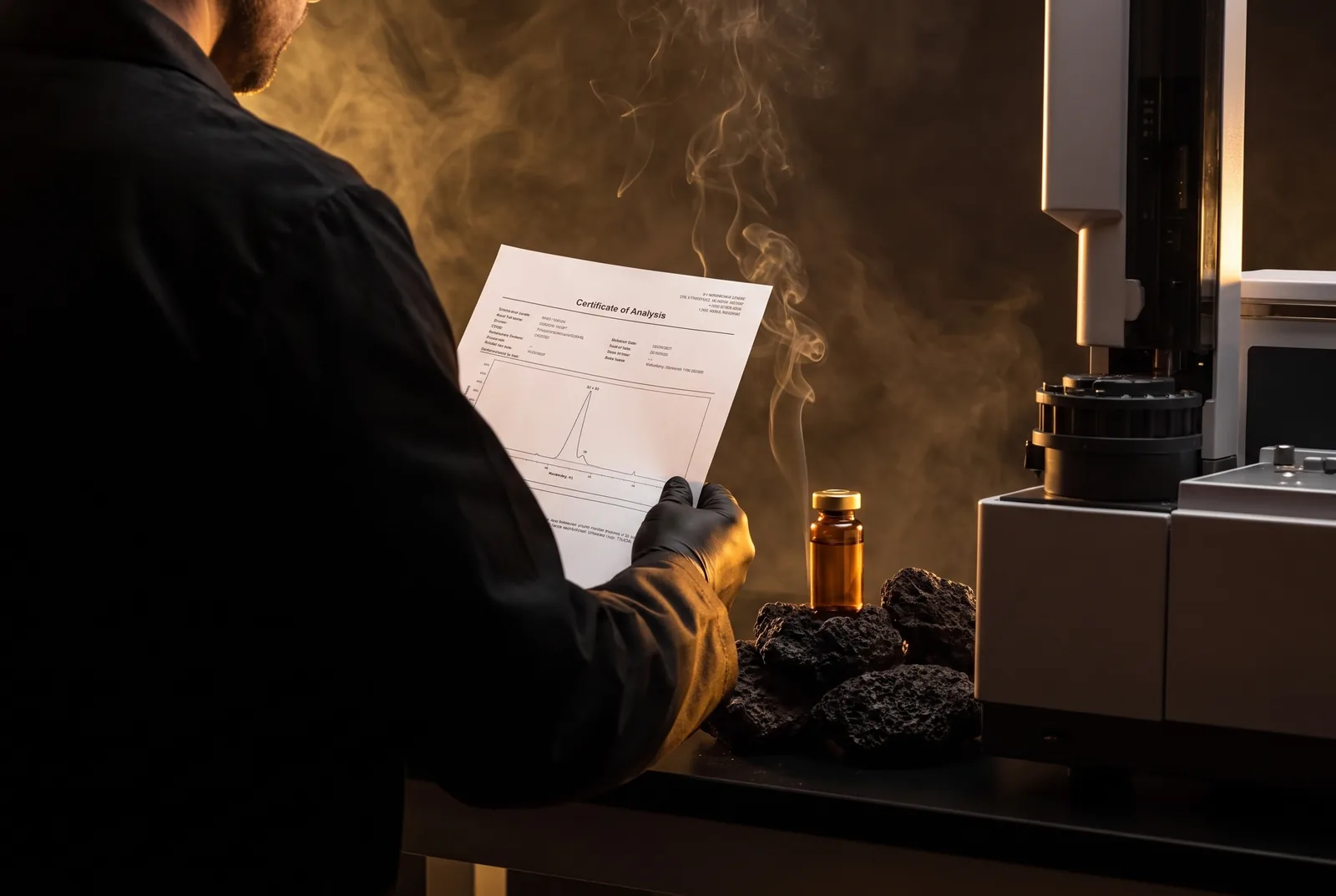
What they give you is a way to read a report. A chain missing two amino acids weighs less than the target, so a mass reading is one place a deletion can show up. A purity method that is named on the report tells you what was measured.
The certificate of analysis page explains what a report lists. The supplier checklist covers what to ask a seller. The glossary defines terms such as HPLC and mass spectrometry, and the quality page describes how testing is set up.
- Which method measured purity?
- Does the report show a mass reading for identity?
- Is the method named on the report?
- Is the full sequence stated?
Questions
Common questions
What is a diketopiperazine?
A ring of two amino acids that can form as a side product while a peptide is built in the lab. It is often shortened to DKP.
Does every peptide form one?
No. One paper says it depends heavily on the sequence. One study found chains with proline in the next-to-last spot were more prone to it. Another calls secondary amino acids extremely prone to it.
What is Fmoc?
A cap on the end of a growing chain. It is removed before the next amino acid is added.