
- 2
- Receptors behind the two familiesGHRH receptor and ghrelin receptor
- 5
- Amino acids in ipamorelinA pentapeptide, described in 1998
- 1998
- Year a review grouped GH-releasing peptides as a class
The short answer
What does growth hormone secretagogue mean?
Secretagogue is a lab word. It labels a compound used in tests of what a cell secretes. Here the thing measured is growth hormone, which labs shorten to GH.
Catalog names in this area fall into two families. They are grouped by the receptor each one is built to fit. A receptor is a protein on a cell surface. A peptide fits into it the way a key fits a lock.
Family one is built from GHRH, short for growth hormone-releasing hormone. GHRH is a natural peptide. Family two is built to fit the ghrelin receptor, which labs call GHSR.
The family tells you what a name means and which papers to read. It does not tell you that two products are the same.
The two families side by side
- Built from the sequence of GHRH
- Made for the GHRH receptor
- Label examples: CJC-1295, TH9507
- Made for the ghrelin receptor (GHSR)
- Some are peptides, some are not
- Label examples: ipamorelin, ibutamoren
Family one
What are GHRH analogs?
GHRH is a natural peptide that has a spiral shape. A 2020 paper used cryo-electron microscopy to image the human GHRH receptor holding its natural partner. It reports that the spiral GHRH touches many parts of the receptor [1].
Labs have edited GHRH for decades. A 1998 study took the first 29 amino acids of human GHRH and swapped one amino acid at a time. It tested each copy in cells. Some swaps kept the activity and others nearly erased it [2].
Another edit guards the front end of the chain. TH9507 adds a small group called trans-3-hexenoyl to the first amino acid of a 44-amino-acid form of GHRH. The paper reports that this slowed the breakdown of the peptide in rat, dog and human plasma samples [3].
CJC-1295 is a third edit. A 2006 paper titles it a long-acting analog of GH-releasing hormone [4]. We cite that paper only for the name it gives the compound.
Family two
What binds the ghrelin receptor instead?
Ghrelin is a natural peptide with an odd feature. A fatty chain is attached at its third amino acid, a serine. A 2024 paper purified ghrelin from cattle, pigs and horses. The attached chain was not the same in all three, and in horses it was shorter [5].
Compounds built for this receptor are a mixed group. A 1998 review described GH-releasing peptides as a class that ranges from small synthetic peptides to peptide-like molecules [6]. So some products in family two are not peptides at all.
Ipamorelin is a clear peptide example. A 1998 paper describes it as five amino acids long, with the sequence Aib-His-D-2-Nal-D-Phe-Lys-NH2. Two of the five are mirror-image D forms, and Aib is not one of the 20 usual amino acids [7].
The same paper measured other hormones in pigs, including ACTH and cortisol, next to GHRP-6 and GHRP-2. The word selective in its title refers to that comparison [7].
Names you may see
| Name | Family | What a source says |
|---|---|---|
| Ipamorelin | Ghrelin receptor | Five amino acids, described in 1998 |
| Ibutamoren | Ghrelin receptor | A non-peptide, imaged on its receptor in 2021 |
| CJC-1295 | GHRH analog | Titled a GHRH analog in 2006 |
| TH9507 | GHRH analog | GHRH 1-44 plus a hexenoyl group |
The receptor
Why does the receptor matter on a label?
A 2021 paper imaged the human ghrelin receptor in two forms. In one it held ghrelin. In the other it held ibutamoren, which the paper calls a non-peptide [8].
That paper also states that ghrelin needs the fatty group on its third amino acid for its action at this receptor [8].
The practical point is simple. Two products can both be called secretagogues and still be unrelated in chemistry. A peptide and a non-peptide can share a category and share nothing else.
So read the category as a hint. The exact name and the sequence are what identify a compound.
A short timeline
How did these families develop?
Several of the papers cited here date from 1998. That year a review grouped GH-releasing compounds into one class [6]. A study also mapped GHRH amino acid by amino acid [2], and ipamorelin was described [7].
Structure work came later. Cryo-EM images of the GHRH receptor and the ghrelin receptor appeared in 2020 and 2021 [1] [8]. These images show where each ligand sits in its receptor.
Dates are also a useful check for a reader. A source from 1998 describes a design idea. It does not describe what a supplier's vial holds today.
Years also separate look-alike names. The 2006 paper names CJC-1295 and the 2007 paper names TH9507. Both compounds belong to family one, and they are different molecules [4] [3].
- 1998
A review groups GH-releasing peptides as a class.
- 1998
Ipamorelin is described as a five-amino-acid peptide.
- 2006
A paper titles CJC-1295 a long-acting GHRH analog.
- 2007
TH9507 is described as a GHRH 1-44 analog.
- 2020
The GHRH receptor is imaged by cryo-EM.
- 2021
The ghrelin receptor is imaged with ghrelin and ibutamoren.
What to check
What should you check before choosing one?
Start with the exact name. A label that says only GH peptide or secretagogue names a category, not a compound.
Next, tie the name to a sequence. Ipamorelin, for one, has five amino acids with non-standard parts. A name that cannot be tied to a sequence is a reason to ask the supplier.
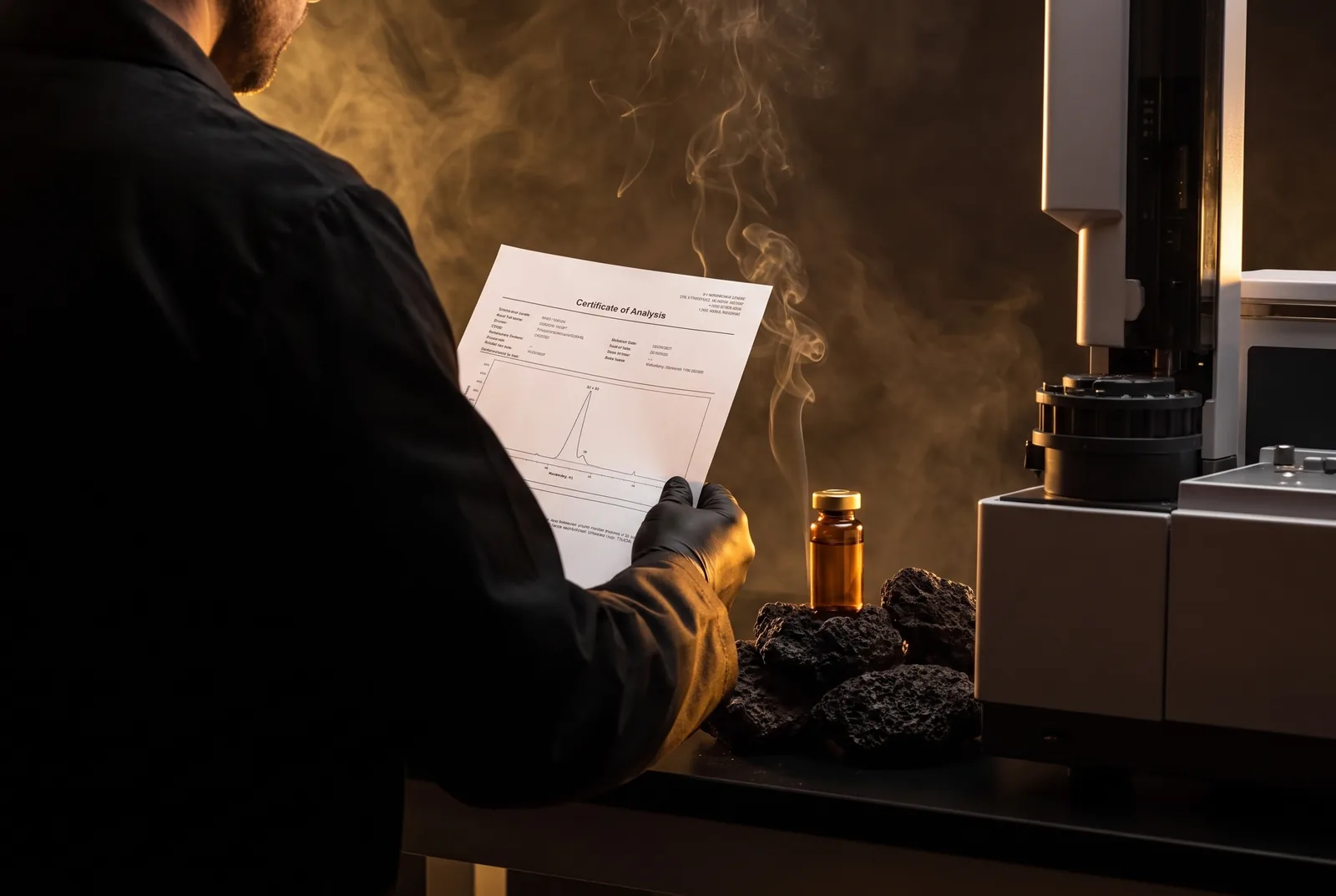
Then ask whether a lab report is posted for that product. The report should show that the lab confirmed the compound and measured its purity. See how our certificates of analysis work.
Last, compare suppliers on the same points. Our supplier checklist lists what to look at, and the glossary explains terms such as analog and sequence.
- 01
Name
Is it an exact compound name, not just a category?
- 02
Sequence
Can the name be tied to a stated sequence?
- 03
Report
Is a lab report posted for that product?
- 04
Compare
Do other suppliers use the same name for the same thing?
Questions
Common questions
Is a secretagogue the same as growth hormone?
No. Growth hormone is a different molecule. Secretagogue is a label for compounds used in studies of how it is released.
Are all of these compounds peptides?
No. Ibutamoren is described as a non-peptide in a 2021 paper. Ipamorelin and the GHRH analogs are peptides.
Does the family name tell me how pure a product is?
No. Purity comes from a lab report for that product, not from the category.
Are these products for people?
No. For laboratory research only. Not for human or veterinary use.