
- 5
- Lab papers on water, acidity and freezing cited here
- pH 4.5
- Where one peptide stayed relatively stable in water at 37 °C
- 1994
- Year of two freeze-dried peptide studies
The short answer
How long does a research peptide last?
There is no single number. How long a vial stays in good shape depends on a few things: whether the peptide is dry or in liquid, how much water is left, how warm it gets, and what else is in the mix. Lab studies have measured each of these. None of them gives one shelf life that fits every peptide.
So the useful question is not how many months. It is what the paperwork says about the product, and how the vial has been handled since. This page explains why, then lists what to ask a supplier.
- Dry or liquid form
- Water left in the powder
- Heat over time
- Acidity of the liquid
- What else is in the vial
What goes wrong
What does breaking down mean for a peptide?
A peptide is a short chain of amino acids. Over time, the chain can change in small ways. Chemists name a few common changes. Deamidation swaps a small piece of one amino acid for another. Oxidation attaches oxygen to part of the chain. Aggregation is when peptide molecules clump together.
In one lab study, a research peptide was kept in water at 37 °C. At pH 5.5 to 6.5, oxidation drove the breakdown. At pH 7.5 to 8.5, deamidation did. Clumping showed up at pH 7.5 and 8.5 [4].
Each change makes a different molecule from the original. A purity test on a certificate can pick up some of them, which is one reason the test date matters.
Deamidation
A small piece of an amino acid is swapped for another, which changes the chain.
Oxidation
Oxygen attaches to part of the chain and changes it.
Aggregation
Peptide molecules stick together in clumps.
Dry cake
Does a freeze-dried peptide still change?
Many research peptides ship as a freeze-dried powder. Freeze-drying removes the water so the peptide sits in a dry cake. Dry is not the same as frozen in time, and the papers show it.
In 1994, a team freeze-dried a six-residue model peptide that contains asparagine. They varied the acidity of the starting solution, the heat and the leftover moisture. The acidity of the starting solution had a significant effect, and the peptide did better at a slightly acidic pH of 3 to 5. Moisture and heat mattered less [1].
The paper also compared the dry cake with liquid. Breakdown in the cake looked much like breakdown in liquid, with one difference in which products formed [1]. So a dry form is not a guarantee that nothing changes.
The same group then tested a similar model peptide that contains aspartic acid. This time the starting acidity was not significant. The bulking agent in the cake mattered most, and moisture and heat also had a significant effect [2].
Two model peptides, two answers
| Model peptide | Mattered | Mattered less or not at all |
|---|---|---|
| Contains asparagine | Acidity of the starting solution | Moisture and heat |
| Contains aspartic acid | Bulking agent, moisture, heat | Acidity of the starting solution |
Water and glass
Why does leftover water matter?
Water left in a dry cake is called residual moisture. A later study kept the asparagine model peptide in a dry polymer. More water and more glycerol, a softener, meant faster deamidation [3].
The paper also split the cakes into two kinds. Glassy cakes are hard and still. Rubbery cakes are soft. In soft cakes with a similar softness, water content did not seem to matter. In hard cakes with a similar softness, more water still meant faster change [3].
The point is not one rule about water. The effect depended on whether the cake was glassy or rubbery.
- More water meant faster deamidation
- More glycerol meant faster deamidation
- Glassy cakes: water content still mattered
- Rubbery cakes: water content did not seem to matter
In liquid
What happens once a peptide is in liquid?
In the 37 °C study, the peptide stayed relatively stable at pH 4.5. Above that, each pH value gave a different pattern of change. Adding sugars such as mannitol, sorbitol or sucrose gave only small protective effects against clumping at pH 7.5 [4].
A second study froze and thawed solutions of a different peptide again and again. The type of sugar in the mix changed when clumping began. Lactose delayed it more than trehalose did. A higher ratio of sugar to peptide meant less clumping with both sugars [5].
Notice what these two studies have in common. Each one changed parts of the mix, such as acidity or the sugar, and watched what happened to the peptide.
Both studies describe one peptide in one liquid. They are not a shelf life for any vial you may hold.
One peptide in water at 37 °C
| Acidity | What the study found |
|---|---|
| pH 4.5 | Relatively stable |
| pH 5.5 to 6.5 | Breakdown driven by oxidation |
| pH 7.5 to 8.5 | Breakdown driven by deamidation |
| pH 7.5 and 8.5 | Clumping detected |
What to ask
What should a supplier be able to tell you?
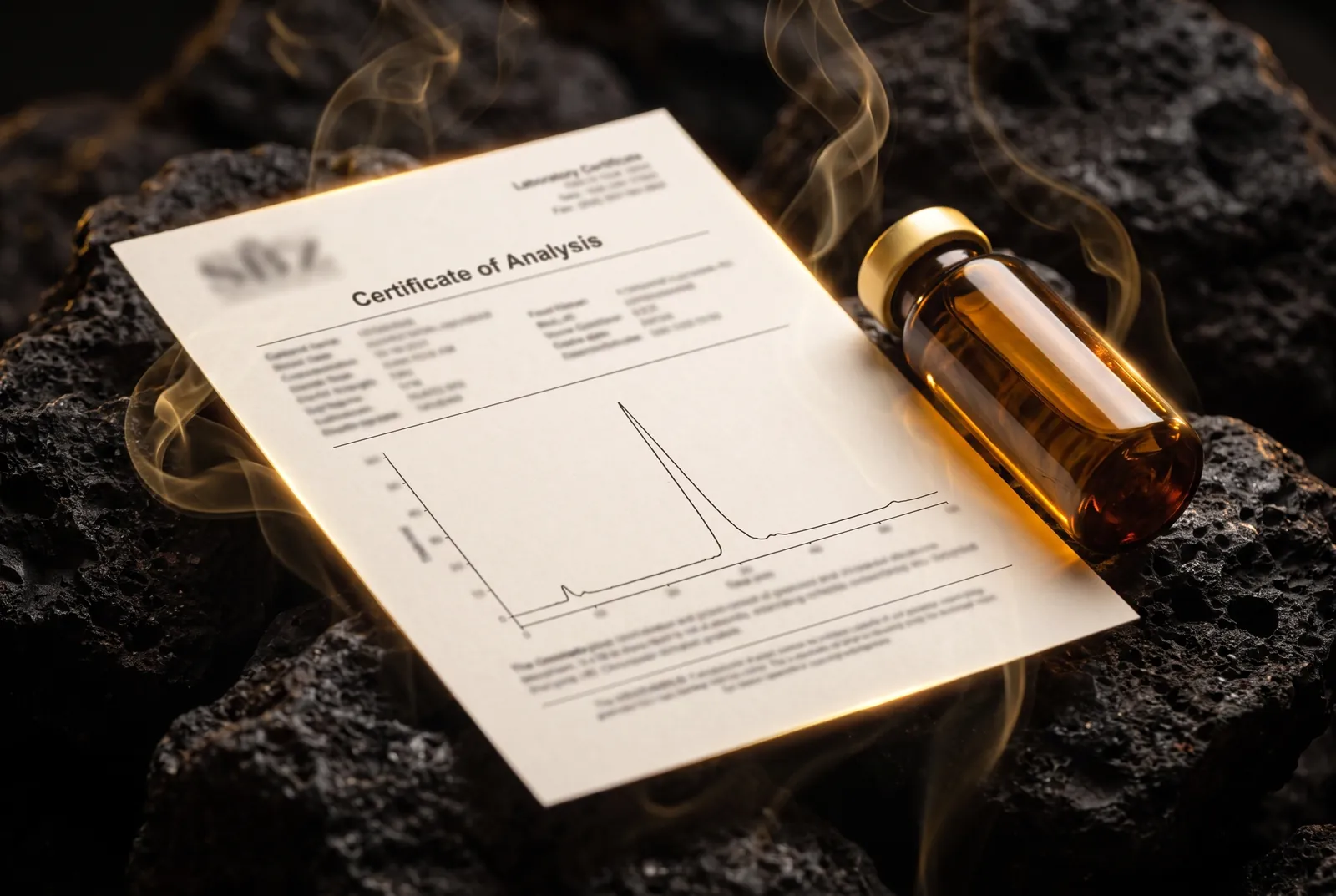
Since no paper gives a universal shelf life, the dependable evidence is test paperwork. A certificate of analysis shows what a lab measured on one sample, on one date.
A certificate describes the sample on its test day. It does not say how a vial has aged since. If a supplier prints one shelf life for every product, ask what test data it rests on. The supplier checklist covers more questions, and how testing works explains the lab side.
- 01
Match the product
The product name and sequence on the vial should match the certificate.
- 02
Read the test date
Note when the sample was tested and which lab tested it.
- 03
Ask what the date rests on
If a supplier states a shelf life, ask for the test data behind it.
- 04
Look at the seal
The stopper should sit flat, the cap should be tight and the glass whole.
- 05
Ask about newer tests
A product that has been on the shelf a while may have newer data.
Limits
What did these studies not test?
These papers used model peptides and specific mixes. None tested a vial of a catalog peptide kept in a buyer's lab, and none gave a number of months.
That is a real limit, and it is worth saying plainly. A supplier who tells you a vial lasts a set number of months should be able to show where the number came from.
Read them as a map of the variables, not as a clock. Water, acidity, freezing and the make-up of the mix all changed the pace of change for the peptides tested. For plain-language definitions of terms on a certificate, see the glossary.
Map versus clock
- Which variables changed the pace
- How the pattern differed by peptide
- How the mix mattered
- A shelf life in months
- A rule for every peptide
- A test of any catalog vial
Questions
Common questions
Does a research peptide have one expiry date?
No single date fits every peptide. Ask the supplier what test data stands behind any date it prints.
What is the difference between purity and stability?
Purity is a snapshot of how much of the vial was the right compound on the test day. Stability is how that holds over time.
Is last year's certificate still useful?
It describes the sample on its test day. It does not show how it has aged since, so ask whether newer data exist.
What is deamidation?
It is a small chemical change in a peptide chain where part of one amino acid is swapped for another.