
- 13,000
- Average process mass intensity, solid-phase synthesisAcross 40 industry processes in one 2024 review
- 168 to 308
- Median for small-molecule drugs in the same review
- 3
- Stages counted: synthesis, purification, isolation
The short answer
Why do two listings for one peptide cost so differently?
The same peptide can come with two very different tags. The gap is rarely luck. It usually comes from how hard the peptide is to make, how much work goes into cleaning it, and how much testing sits behind the vial.
This page walks through each of those costs in plain words. Then it gives you a short list to run on any listing before you compare. Nothing here says one number is right. It shows what a cost can and cannot tell you.
A small number is not a flaw by itself. A small number with no paperwork is a gap you cannot check.
Making it
Why are some peptides harder to make?
Labs build a peptide one amino acid at a time, in a repeating cycle. Each cycle can miss a little. A longer chain means more cycles, so more chances for a miss.
Some sequences are harder than others. A 2026 study looked at how the mix of amino acids drives clumping while a peptide is being built. It found that composition predicted clumping better than the order of the sequence did [1]. Clumping limits how well and how reliably the build runs.
Cost also depends on how many lots miss the mark. A lot that fails its checks has to be made again. The next lot carries that lost time and material.
A hard build can mean more time, more material and more lots that need a redo. That work shows up in what a supplier has to charge.
- A longer chain with more cycles
- A mix of amino acids that tends to clump
- Repeat builds when a lot misses its mark
- More time on the instrument
Materials
How much material goes into one batch?
Solid-phase synthesis uses a large excess of solvents and reagents [2]. A group of 14 pharmaceutical companies pooled data on 40 peptide processes to measure this. Their measure is called process mass intensity. It is the total weight of everything that goes in, compared with the weight of peptide that comes out.
The average for solid-phase peptide synthesis was about 13,000. For small-molecule drugs the median was 168 to 308 [2]. So making a peptide takes far more input per gram than many other products.
A review of greener methods describes the same problem: a lot of waste solvent that someone has to handle [3]. Buying that solvent and handling that waste are real costs for any maker.
The three stages the review counted
| Stage | What happens |
|---|---|
| Synthesis | The chain is built one amino acid at a time |
| Purification | The wanted peptide is separated from look-alike by-products |
| Isolation | The cleaned peptide is turned into a dry powder |
Purity
What does a cleaner peptide involve?
After the build, the crude product holds the wanted peptide plus by-products. Some by-products look a lot like the real thing. Purification separates them. The more by-products a lot starts with, the more work this step takes.
Labs then check the result. HPLC, a chromatography test, is one of the tools used to assess peptide content and impurities. Mass spectrometry and NMR are used to check identity [5].
Think of a purity figure as the last line of a long process. It tells you where the lot ended up. It does not tell you how many rounds of cleaning it took to get there.
So a purity figure is the end of a chain of work. If a listing shows a figure with no method and no lab, you cannot tell how it was reached.
Weight on the label
Why does the label weight not tell the whole story?
Peptides come out of synthesis as salts. The acid used to cut the peptide from its carrier and to clean it, called TFA, stays behind as a counterion [4]. A counterion is a small charged partner that travels with the peptide.
A 2025 study from ETH Zurich removed TFA by freeze-drying the peptides in hydrochloric acid. It measured what was left with three different methods. The authors wrote that counterion content should be measured and stated [4].
This matters when you compare listings. A vial of powder weighs the peptide plus its counterion plus water. Two vials with the same label weight can hold different amounts of actual peptide. The page on net peptide content explains how to read that figure.
- The peptide itself
- The counterion, such as TFA
- Leftover water
- Only a certificate can say how much of each
- Counts all the powder
- Says nothing about the counterion
- Cannot be compared across suppliers
- Names the counterion
- States how much is peptide
- Lets you compare cost per milligram of peptide
Paperwork
What does testing add to the cost?
Testing a lot costs money. Peptide quality tests lean on reference standards, which are well-characterized materials used to judge identity, purity and strength [5]. Making and checking those standards is its own project.
A supplier that sends every lot to an outside lab pays that lab each time. A supplier that skips this pays nothing, and the listing shows nothing. That is one honest reason a listing can cost less.
There is also the cost of the paperwork itself. A lot-specific certificate is one document for one lot. A generic PDF is one document for many lots. The first costs more to produce and tells you more. The guide on lot-specific versus generic certificates shows how to spot each.
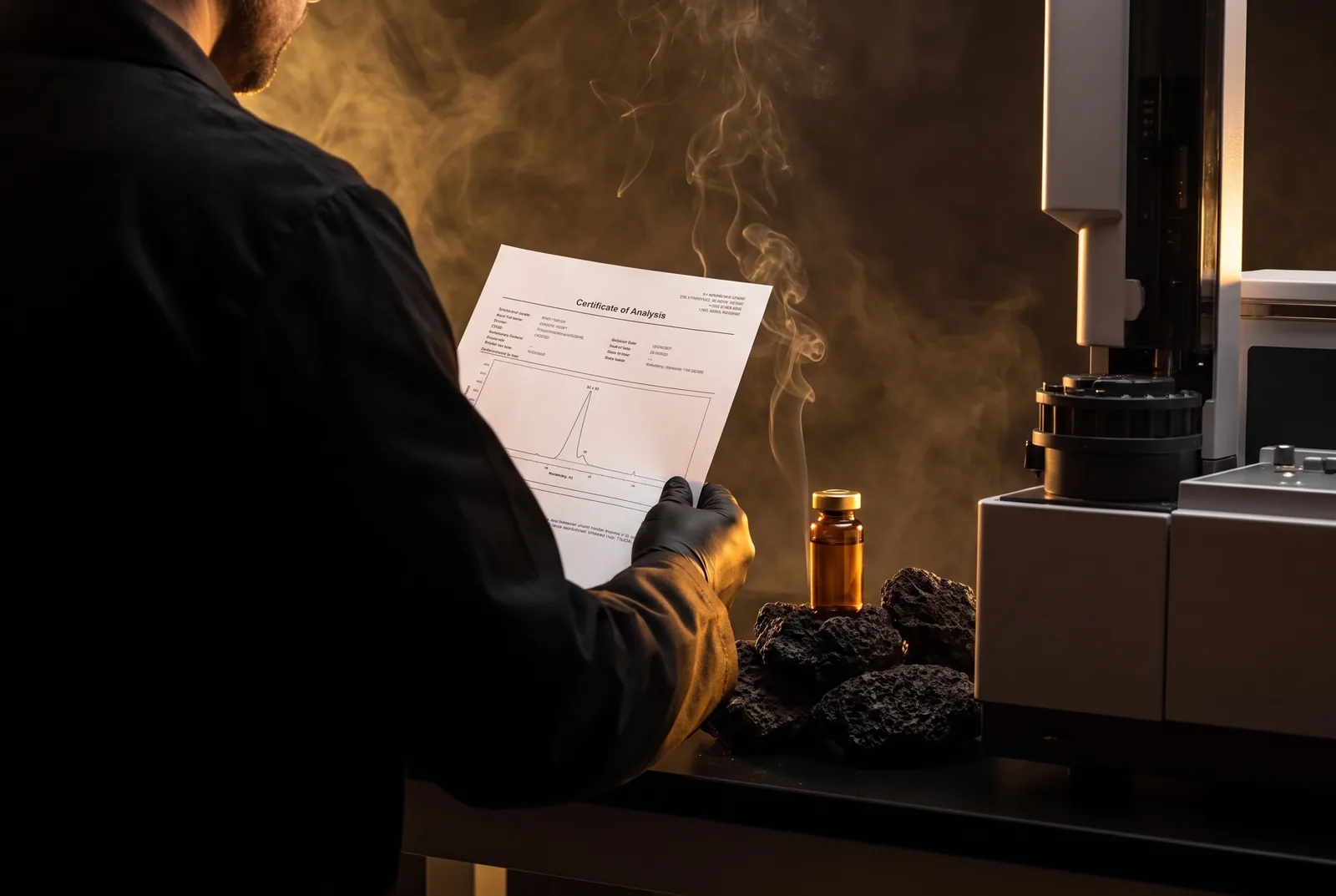
The way to see the difference is the certificate. Look for a named lab, a lot number that matches your vial, and the methods used. Our guide on how to read a certificate of analysis goes line by line. You can also look up a lot on the certificate page.
Your checklist
What should you compare before choosing?
Set the cost aside for a minute. Put the two listings side by side and ask the questions below. If both answer well, the gap is probably real work. If one cannot answer, you have found the gap.
Our supplier checklist covers more checks. The page on third-party testing versus in-house testing explains one of the biggest cost differences.
- Is the lab named, with a report number?
- Does the certificate match the lot number on the vial?
- Are the purity and identity methods stated?
- Is the counterion or net peptide content shown?
- Is the amount per vial the peptide or the whole powder?
Questions
Common questions
Is a cheaper peptide worse?
Not always, and not never. The cost alone does not say. The certificate does. Check the lab, the lot number and the methods.
Why does a longer peptide usually cost more?
A longer chain takes more build cycles, and each cycle can miss a little. More cycles also mean more material and more cleaning work.
What is a counterion?
It is a small charged partner that travels with the peptide in the powder. TFA is a common one. It adds weight to the vial.
What is net peptide content?
It is the share of the powder that is the peptide itself. The rest is counterion, water and salts.
Can I compare two listings without a certificate?
Not well. Without a certificate you cannot see the purity method, the lab or the lot. You would be comparing labels only.