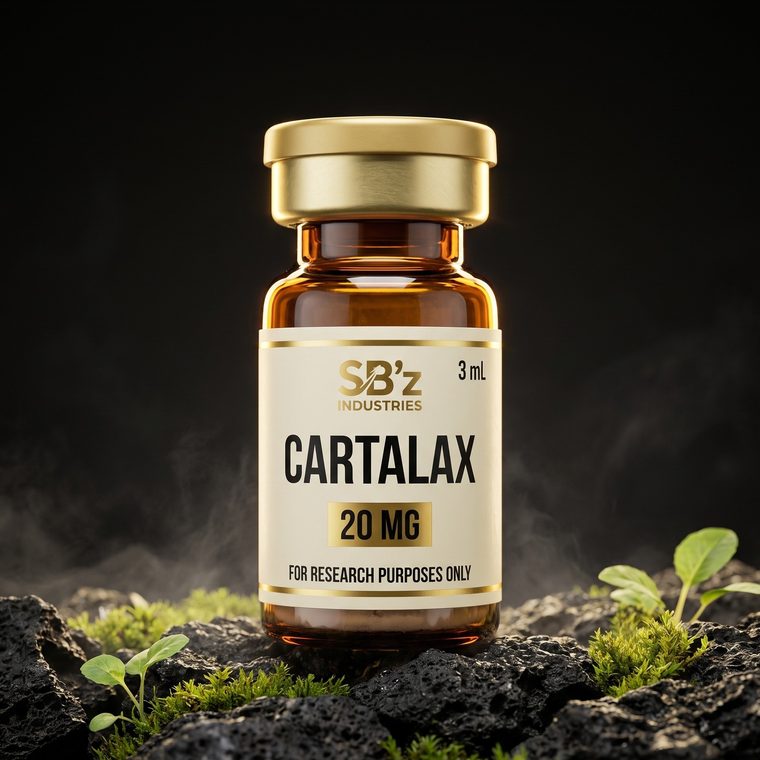
What is Cartalax?
Cartalax is a branded name put on a very short synthetic peptide, just three amino acids long: alanine, glutamic acid, and aspartic acid, often written as AED. It comes out of a Russian research program that spent decades making short peptides loosely modeled on natural signals found in body tissues, in Cartalax's case, cartilage. The idea is that a tiny fragment might nudge a specific tissue's cells the way a single word can shift the tone of a sentence, without needing the whole original protein. SBz Industries sells it for laboratory research only.
Is Cartalax the same as the peptide AED?
Cartalax is a brand name; AED (Ala-Glu-Asp) is the three-amino-acid peptide behind it. The published research is on the AED peptide itself, done by the lab that developed it, not on a product called Cartalax specifically.
Has Cartalax been tested in cartilage tissue?
Not in any published study we could find. Despite the cartilage-linked name and origin, the available cell-culture research has actually looked at skin cells and bone-marrow stem cells, not cartilage cells.
How is Cartalax reconstituted?
Cartalax ships as a freeze-dried powder. Mix it with bacteriostatic water, added slowly down the inside wall of the vial, and let it dissolve without shaking. The researcher decides the working concentration, not us, and we publish no protocols.
How should Cartalax be stored?
Store as stated on the product page and the certificate of analysis. Vials ship in plain outer packaging with no product name on the outside.
Is Cartalax tested, and can I see the results?
Yes. An independent lab tests every compound: it confirms the compound is what the label says and measures purity by HPLC. The latest certificate is on the product page, and you can read it before you order.
Who is permitted to purchase Cartalax?
Researchers and institutions, 21 or over. By ordering you confirm the material is for laboratory research and will not be used in humans or animals.