

Cold chain and transit risk
Freeze-dried peptide handles ordinary shipping temperatures better than most people expect. The real risks in transit are temperature swings, condensation when you open the vial, and a box that sat somewhere nobody recorded.
Why dry material survives the truck
The degradation routes that matter, hydrolysis and deamidation, need water. A properly lyophilized cake at a few percent residual moisture does not have enough of it for either to run at a meaningful rate, and that remains true at thirty degrees as well as at four.
So a week at ambient does very little to a dry powder, which is why peptides ship without refrigeration routinely and correctly. It is also why the cold pack in the box is doing less than it appears to be, and why a shipment that arrives with the ice melted is not, on its own, a problem.
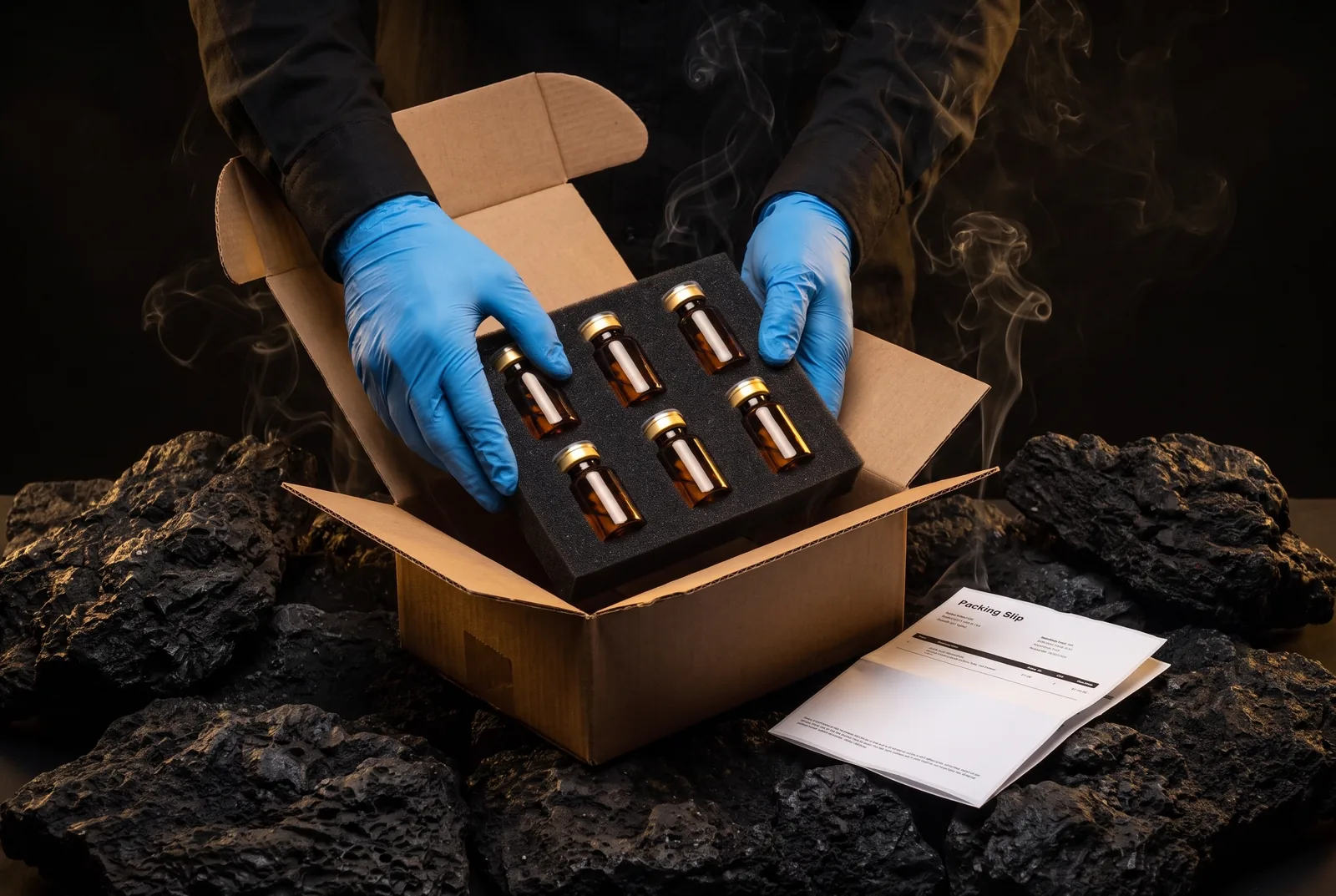
What costs material in transit
Temperature cycling
Repeated warming and cooling matters more than a single warm stretch. Each cycle moves moisture around inside the vial and, for anything already in solution, drives aggregation. A parcel that goes warm once and stays warm is in better shape than one that swings daily for a week.
Condensation on arrival
The most damaging moment in the whole journey is often the first thirty seconds in the laboratory. A cold vial opened immediately pulls atmospheric moisture straight onto hygroscopic powder. Let it reach room temperature first.
Unrecorded delays
A parcel held at a customs facility or sitting in a distribution center over a weekend has a gap in its history. The material is usually fine and the documentation no longer describes a known thermal history, which is a different kind of problem.
Physical damage
A cracked vial or a lifted stopper breaks the seal, and a broken seal on hygroscopic material is a moisture problem regardless of temperature. It is also the one failure that is visible without any instrument.
On arrival
- 01
Photograph the box before unpacking
If there is a claim to make, the state of the packaging is the evidence, and it stops being available the moment the box is opened.
- 02
Check seals and stoppers before temperature
A lifted stopper or a hairline crack matters more than whether the cold pack survived. Seal integrity is the thing that determines whether the contents are still what the certificate describes.
- 03
Let vials equilibrate
Twenty to thirty minutes at room temperature before anything is opened. This is the single highest-value step on the list and it costs nothing.
- 04
Match vials to the packing slip
Check each vial label against the packing slip: compound and size. Anything that does not match, do not open. Contact the supplier with the order number.
- 05
Move to the storage condition the certificate assumes
Whatever the retest date was written against. Storing colder than that is fine; storing warmer voids the date.
What a supplier can reasonably be asked for
A shipping method and a stated transit time. Whether the material ships with a cold pack and what that is expected to achieve. What the supplier's policy is when a parcel is delayed in transit beyond the stated window.
What cannot reasonably be promised is a continuous temperature record, unless there is a data logger in the box, and for research material at this scale there usually is not. A supplier claiming an unbroken cold chain with no logger to show for it is describing an intention, not a measurement.
Questions
Common questions
A shipment arrived warm. Is the material compromised?
Almost certainly not, if the vials are sealed and the powder is dry. Lyophilized peptide tolerates ambient transit; a cold pack, where a supplier uses one, stays cold for far less time than the material stays stable. Check the seals and the cake, which are the informative signals.
How long can a dry peptide sit at room temperature?
Weeks to months for most sequences, which comfortably covers any normal transit. It is not a storage condition and it is not a transit emergency either.
Should a shipment be refused if it was delayed?
Not on delay alone. Inspect seals, inspect the cake, check each vial against the packing slip. If all three are good the material is very likely intact; if the seal is broken the delay is beside the point.
Is a temperature logger worth requesting?
For a large order or material that will be stored a long time, yes, and expect it to add cost. For a routine shipment of dry powder it is measuring a variable that dry powder is largely indifferent to.
Cite as: SBz Industries research library, "Cold chain and transit risk", https://www.sbzindustries.com/research/cold-chain, updated 2026-09-11.
Keep reading
Related guides
Documentation
Every compound, its certificate published
We expect the checks on this page to be run on our own paperwork. The latest certificate for every compound is on its product page.