
Why peptides ship freeze-dried
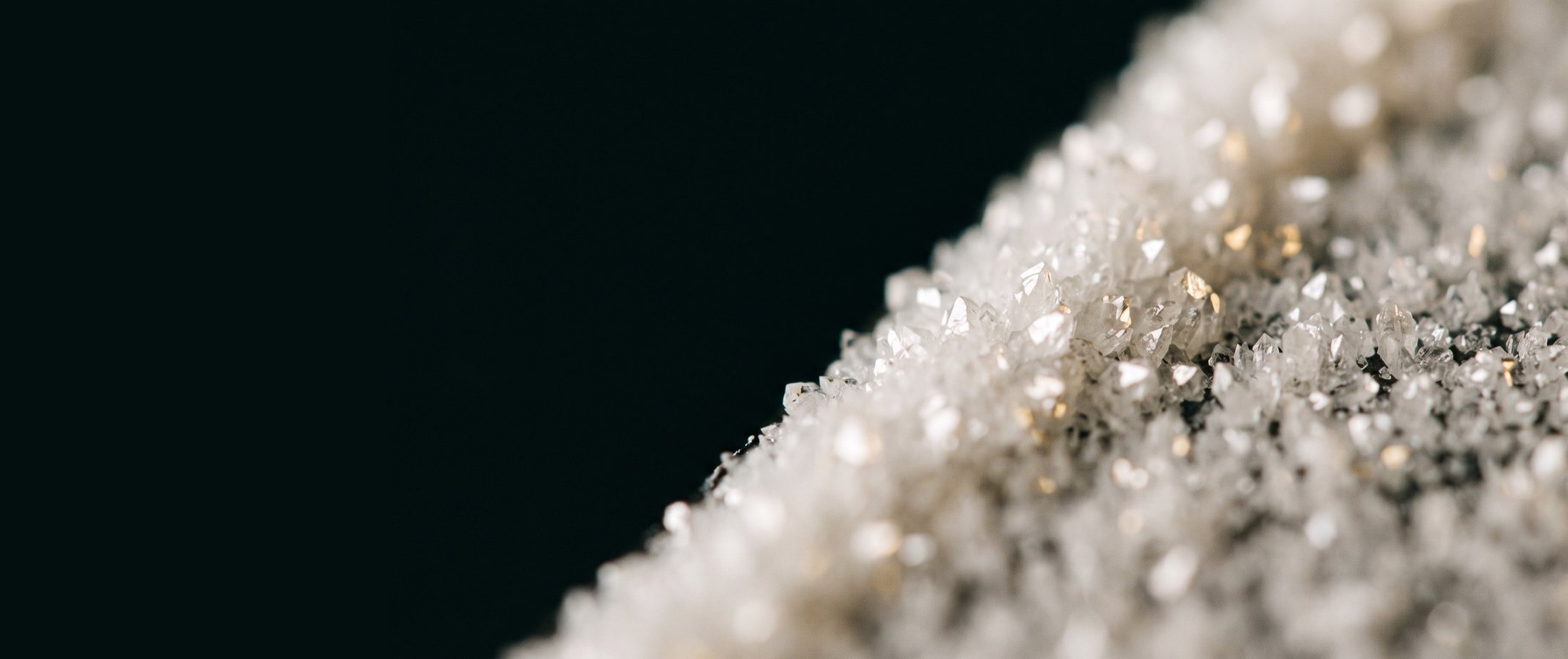
Freeze-drying removes water by sublimation, ice going straight to vapor, instead of by evaporation. The cake it leaves behind is why the powder keeps, and it is also a visible record of whether the process ran correctly.
What the process does
The solution is frozen, then held under vacuum while heat is applied carefully enough that ice passes straight from solid to vapor without melting. Water leaves, the solid structure stays where it was, and what remains is a porous cake occupying roughly the volume the frozen solution did.
That porosity is why lyophilized material redissolves quickly. Evaporating the water instead would leave a dense residue that takes much longer to go back into solution and that traps solvent inside itself.
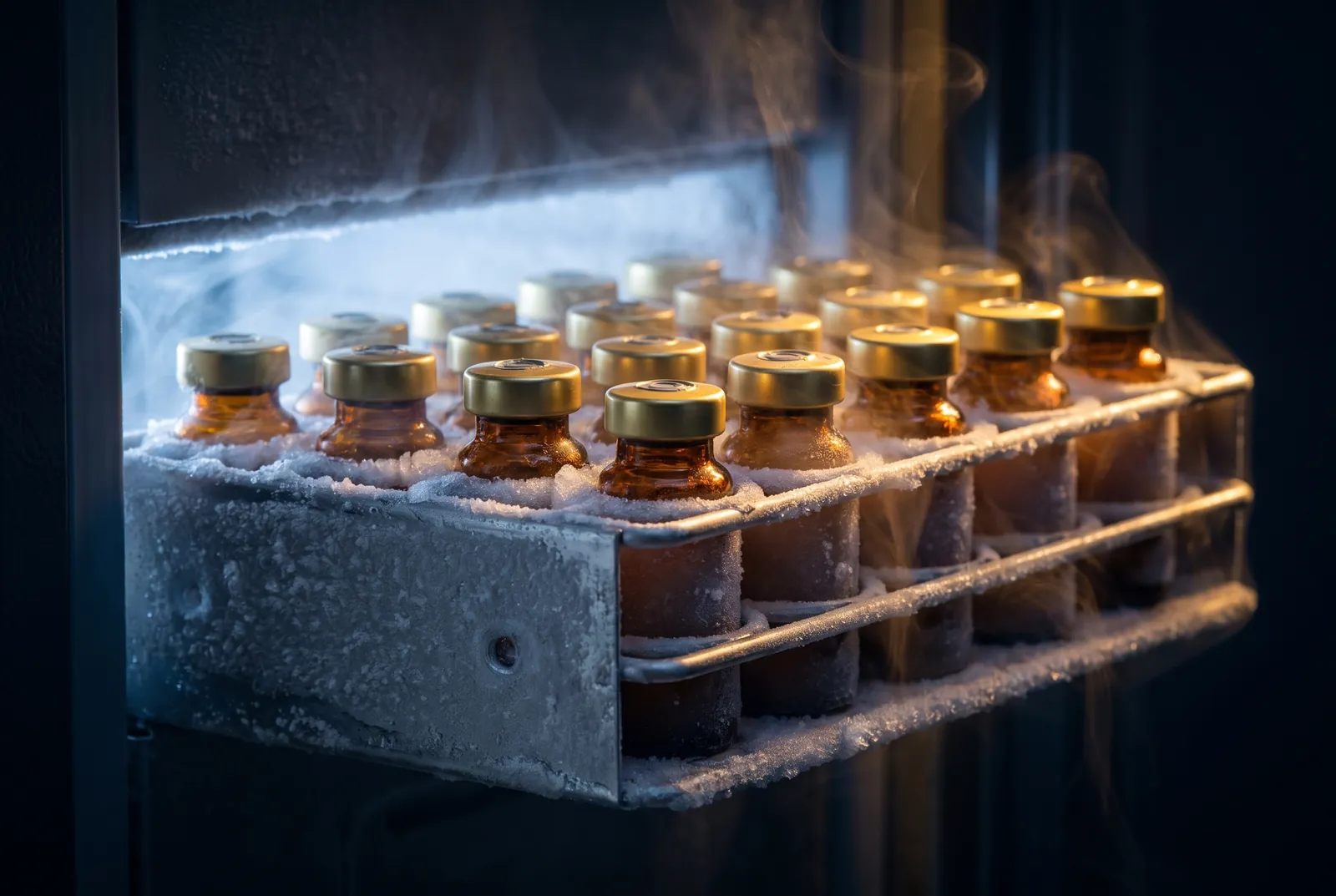
The reason for doing any of this is stability. Hydrolysis and deamidation both need water. Take the water below a few percent and both effectively stop, which converts a material with a shelf life measured in days into one measured in years.
The three stages
- 01
Freezing
The solution is cooled below its freezing point, and how fast that happens sets the ice crystal size and therefore the pore structure of the finished cake. Fast freezing gives small crystals and a fine structure that dries slowly; slow freezing gives large crystals and a more open cake.
- 02
Primary drying
Vacuum is applied and gentle heat drives sublimation of the free ice, which is the bulk of the water and the longest stage. Product temperature has to stay below the collapse temperature throughout. Above it, the partially dried solid loses its structure and slumps.
- 03
Secondary drying
Temperature is raised to pull off the bound water still associated with the solid, taking residual moisture down to the low single digits. Karl Fischer titration on the finished material is what confirms it got there.
Reading the cake
Intact and uniform
A white to off-white solid holding its shape and filling roughly the volume the solution did. This is the process running as intended.
Collapsed or glassy
A shrunken plug, a film on the bottom, or a glassy appearance. The product went above its collapse temperature, in primary drying or later in transit. Residual moisture is usually higher than specified and stability is compromised.
Barely visible
Not a fault. A few milligrams of peptide spread across a vial floor can look like almost nothing, and for small fills a thin film is the expected appearance rather than a sign of a short fill.
Why a shrunken cake matters even when the peptide still works
Collapse is a process deviation, and the useful thing about it is that it is visible. A vial that arrives with a slumped cake has been warm, or has been under insufficient vacuum, or was dried too aggressively. Any of those means the residual moisture figure on the certificate was measured on material that did not have this history.
The peptide inside is frequently fine. The documentation, however, no longer describes the vial in your hand, and that is worth raising with a supplier regardless of whether the material performs.
Questions
Common questions
Why does one vial have a visible cake and another look empty?
Fill mass and whether an excipient is present. A few milligrams of pure peptide across a vial floor is close to invisible. A formulation with mannitol or trehalose produces a solid, obvious cake at the same peptide load.
Is a collapsed cake unusable?
Usually not, but it has been through a thermal or vacuum excursion the certificate does not account for, so the stated moisture and the retest date behind it no longer apply to that vial.
Does lyophilization purify anything?
No. It removes water and volatiles. Purification happened upstream at the preparative chromatography step, and anything non-volatile that survived that is still in the cake.
Why is residual moisture specified so tightly?
Because water is the reagent in hydrolysis and deamidation. Below a few percent both routes are slow enough to ignore. Above it they run, and the stability the whole process exists to provide goes away.
In the catalog
Compounds this applies to
Cite as: SBz Industries research library, "Why peptides ship freeze-dried", https://www.sbzindustries.com/research/lyophilization, updated 2026-09-11.
Keep reading
Related guides
Documentation
Every compound, its certificate published
We expect the checks on this page to be run on our own paperwork. The latest certificate for every compound is on its product page.