
- 7
- Amino acids in SemaxPositions 4 to 7 of ACTH plus a Pro-Gly-Pro tail
- 29
- Amino acids in hGRF(1-29), the parent of CJC-1295
- 4 vs 3
- Disulfide bonds: new insulin analogs vs natural insulin
The short answer
What does analog mean on a peptide label?
An analog is a peptide built on the plan of another peptide, with one or more planned changes. The original is called the parent. The analog keeps most of the parent's design and changes a few things on purpose.
A peptide is a short chain of amino acids. Amino acids are the small building blocks that link together to make it. A change can swap one amino acid for another, add a piece, or alter the shape. A 2017 review from Stanford calls this editing a natural peptide sequence. It lists changing L-form amino acids to D-form, closing a peptide into a ring, and using unnatural amino acids as common edits [1].
So the word tells you two things. The compound is related to a natural peptide, and it is not the same molecule. Two vials with similar names can hold different compounds with different sequences.
This page explains the idea in plain words, shows examples from published papers, and ends with what to check on a label when you read a vial label.

How they are made
What kinds of changes make an analog?
Most analogs come from a short list of edits. Each edit changes the molecule in a way a lab can name and check.
One edit swaps an amino acid for a different one. Another adds a small cap to one end of the peptide. A third attaches a larger piece, such as a polymer chain or a carrier protein. A fourth changes the shape, for example by closing the peptide into a ring.
Labs make these edits because natural peptides are often limited by fast breakdown. The Stanford review says natural peptides are often limited in use by rapid proteolysis, which means cutting by enzymes called proteases, and by poor passage through membranes [1].
An edit is usually small on paper. A single letter in a sequence can mark a swap. That is why the exact name and sequence matter more than the family word.

Swap
One amino acid is replaced by a different one.
Cap
A small group is added to the front or back end.
Attach
A larger piece, such as a chain or a carrier protein, is linked on.
Reshape
The peptide is closed into a ring or built with mirror-image amino acids.
Real examples
Which papers describe analogs?
Four papers show how different the edits can be. Semax is a seven amino acid peptide. A 2016 study from the Italian National Research Council describes it as covering positions 4 to 7 of a hormone called ACTH, plus a Pro-Gly-Pro tail at the end. The same study compared Semax with a version that has an acetyl cap on its front end. It tested how each one binds copper and zinc ions, in the lab and in a human cell line [3].
CJC-1295 starts from the first 29 amino acids of human growth hormone-releasing factor, written hGRF(1-29). A 2005 paper made three versions with a reactive group that can bond to the blood protein albumin. It describes CJC-1295 as a form with four substitutions and an added lysine at the end. The authors tracked how long it stayed in rat plasma and report it present beyond 72 hours [2].
Another group took the same GRF(1-29) peptide and attached one polyethylene glycol (PEG) chain to lysine 12 or lysine 21. They compared that analog with the plain peptide in rats and pigs [4].
A Novo Nordisk review covers insulin analogs with a fourth disulfide bond. A disulfide bond is a link between two sulfur atoms that holds a peptide in shape. Natural insulin has three. The authors report several active four-bond analogs and describe markedly improved stability [5].
Examples from the papers above
| Name | Parent | What changed |
|---|---|---|
| Semax | ACTH positions 4 to 7 | A Pro-Gly-Pro tail at the end |
| Ac-Semax | Semax | An acetyl cap on the front end |
| CJC-1295 | hGRF(1-29) | Four substitutions and an added lysine linker |
| GRF-1PEG(5000) | GRF(1-29)NH2 | One PEG chain on lysine 12 or 21 |
| Four-bond insulin analogs | Human insulin | A fourth disulfide bond |
Why labs make them
Why do labs build analogs?
In the CJC-1295, insulin and R4F4 papers, stability is a stated goal. A natural peptide may be cut up by enzymes before a test is finished. An analog can be built to hold up longer in the test.
The CJC-1295 paper began with extending plasma half-life as its aim. It reports that all three albumin versions held up better in the lab against an enzyme called dipeptidylpeptidase-IV [2].
A 2026 University of Reading paper tested a short arginine-rich peptide called R4F4. It also tested a D-amino acid version and a ring version. Amino acids come in mirror-image forms called L and D, and natural peptides use the L form. The authors report that the original had reduced activity in bacteria tests when serum and trypsin, an enzyme that cuts peptides, were present. They report that the ring and D-form versions held up better with proteases present [6].
In the CJC-1295, Semax, PEG and R4F4 papers, the analog was tested next to its parent. The authors treated them as separate compounds with separate results.
Parent and analog
- Most of the amino acid order
- A recognizable stretch of the parent sequence
- One or more amino acids
- An end cap or an added tail
- A chain, a link or a ring
On the label
How can you tell an analog from its parent?
Start with the name. Semax and CJC-1295 are names for specific compounds. Neither name is the name of the parent hormone. A vial of one is not a vial of the other.
Next, find the parent. Product pages such as Semax and CJC-1295 name the compound. The glossary at the research glossary explains terms like sequence and residue.
Then compare the written sequence with the parent's. Each letter stands for one amino acid, so a swap shows up as one letter changing. An added cap or chain may show as extra text in the name.
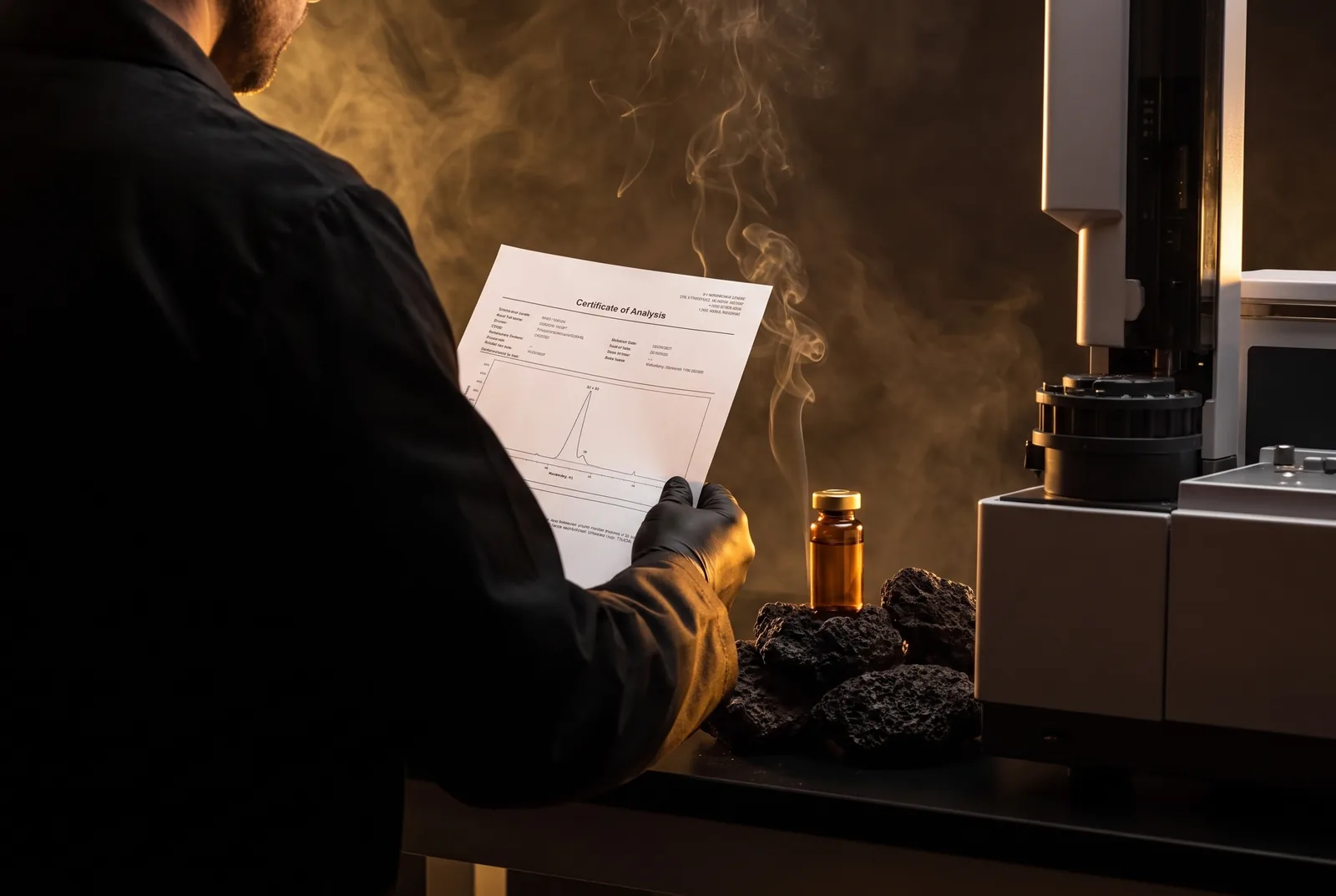
Finally, check the lab report. Where a report is posted, it should name the exact compound on the vial. Open the lab reports and look for that name. If the report names the parent but the vial carries the analog name, or the other way round, ask about it.
- 01
Read the name
An analog name should point to one specific compound.
- 02
Find the parent
Look up the natural peptide it was built from.
- 03
Compare the sequence
A swap shows up as one changed letter.
- 04
Match the report
The lab report should name the exact compound on the vial.
Reading a label
What should you ask about an analog?
Analog is a family word. It does not say how a compound was made, how pure it is, or whether a lab has checked it.
Ask for the exact name, the parent and the change. Ask whether a lab report names that exact compound. Ask what the lab tested, such as identity and purity. The supplier checklist lists more checks.
The papers above report lab work in test tubes, cells, bacteria, rats and pigs, along with two reviews. For laboratory research only. Not for human or veterinary use.
- What is the exact name of this compound?
- What is the parent peptide?
- What was changed, and where?
- Does the lab report name this exact compound?
- What did the lab test: identity, purity or both?
Questions
Common questions
Is an analog the same as the original peptide?
No. It is a related compound with planned changes, so it has its own sequence, its own name and its own results.
What is a parent peptide?
It is the natural peptide or fragment an analog was built from. In the 2005 paper, hGRF(1-29) is the parent of CJC-1295.
Is it analog or analogue?
Both spellings mean the same thing. Analog is the US spelling. Some papers write analogue.
Does the word analog tell me how pure a compound is?
No. Purity comes from a lab test, not from the word on the label.