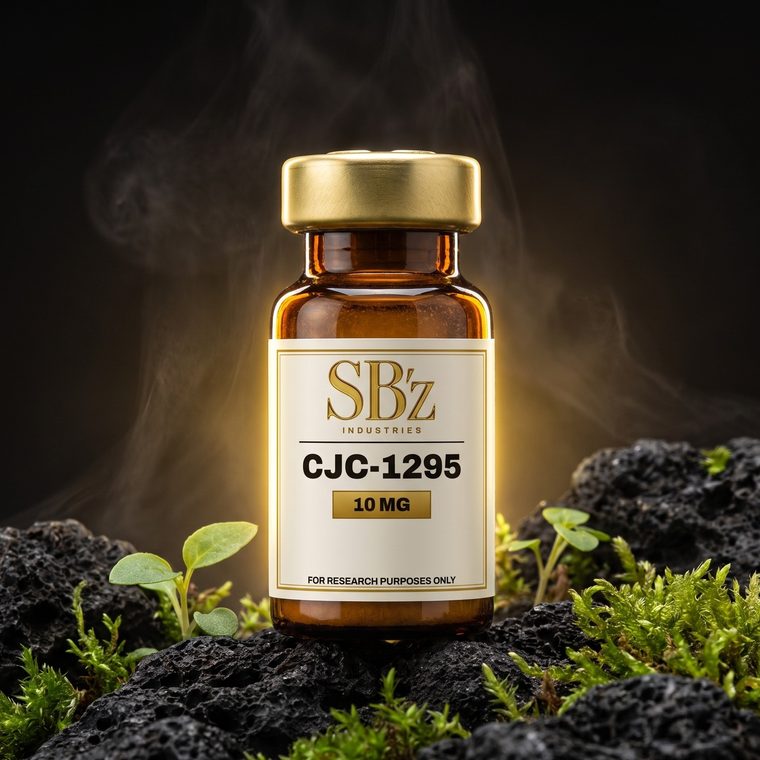
What is CJC-1295?
CJC-1295 started life as a copy of the first 29 building blocks of growth hormone-releasing hormone, the natural signal that tells the pituitary gland to release growth hormone, with one added trick. The original version was chemically tagged so it would stick to albumin, a protein always floating in the blood, the way a magnet stuck to a passing truck gets a free ride and stays in circulation far longer than it would alone. That long-acting, albumin-binding version is technically distinct from 'CJC-1295 without DAC,' a shorter form of the same core molecule that behaves more like a quick, short-lived growth hormone signal. SBz Industries sells it for laboratory research only.
Is 'CJC-1295 without DAC' the same molecule studied in the human trials?
Not exactly. The published human trials used the version with the albumin-binding tag attached, sometimes called 'with DAC,' built specifically to last longer in the blood. The 'without DAC' version lacks that tag and doesn't appear to have been tested on its own in a published human trial.
What does DAC stand for?
Drug Affinity Complex, the industry term for the chemical tag that lets the molecule bind to albumin in the blood and stick around much longer than it otherwise would.
How is CJC-1295 reconstituted?
CJC-1295 ships as a freeze-dried powder. Mix it with bacteriostatic water, added slowly down the inside wall of the vial, and let it dissolve without shaking. The researcher decides the working concentration, not us, and we publish no protocols.
How should CJC-1295 be stored?
Lyophilized: -20C, protected from light. Reconstituted: 2-8C. Vials ship in plain outer packaging with no product name on the outside.
Is CJC-1295 tested, and can I see the results?
Yes. An independent lab tests every compound: it confirms the compound is what the label says and measures purity by HPLC. The latest certificate is on the product page, and you can read it before you order.
Who is permitted to purchase CJC-1295?
Researchers and institutions, 21 or over. By ordering you confirm the material is for laboratory research and will not be used in humans or animals.