Online ordering is open. Ships in 1 to 2 business days. Tracked 2-day shipping, plain box. Every compound third-party tested

For laboratory and research use only. Not for human or veterinary use.

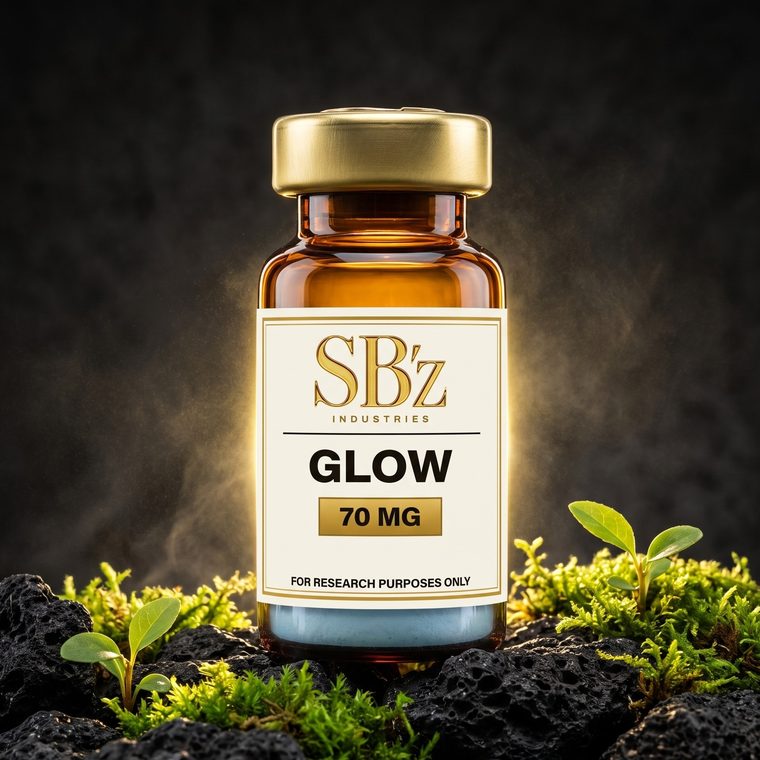
GLOW

Three-component research blend, sold for laboratory research.

1
size
HPLC
purity, third-party tested
GLOW vial
$75per vial

Identity

What GLOW is

GLOW is not a peptide on its own, it's a mixed product made by combining three separate peptides: GHK-Cu, TB-500, and BPC-157. Each of the three has its own individual research trail, but the three-peptide combination sold under the name GLOW has not itself been the subject of any published study. It is a supplier-assembled stack, not a molecule that shows up in a research paper under that name.

GLOW is a three-component research blend. SBz Industries sells it for laboratory research.

CAS number
Not applicable, blend
Compound class
Three-component research blend
Appearance
Lyophilized powder
Solubility
Soluble in bacteriostatic water
Storage
Lyophilized: -20C, protected from light. Reconstituted: 2-8C.
Available sizes
70 mg

Research

What the research has looked at

In plain terms, with a link to every study. The most useful thing to notice is what each study was done in.

Of the three ingredients, BPC-157 has the largest research base, summarized in a 2025 review of 36 studies, 35 of them in animals and only one in people. GHK-Cu has its own separate history, covered in a 2018 review. A 2026 rat study looked at BPC-157 and TB-500 given together, though not alongside GHK-Cu, and found the pair performed no better on a healing tendon than either peptide alone. No paper has tested all three GLOW ingredients as one combined product.

rats2026

Thirty-two rats had their Achilles tendon cut and surgically repaired, then were split into four groups of eight, untreated, BPC-157 alone, TB-500 alone, and both together; researchers measured how much force the tendon could take before failing and examined the tissue under a microscope, finding the combined group did not outperform either peptide given by itself.

Effects of BPC-157 and TB-500 on Achilles tendon healing in rats: A histopathological and biomechanical study.
Biçer and colleagues, Joint Diseases and Related Surgery

review2025

A 2025 review pulled together 36 published studies on BPC-157, 35 done in animals and one in people, reporting better outcomes in animal models of muscle, tendon, ligament, and bone injury, while noting the human evidence is limited to a small retrospective look at knee injections in 12 patients.

Emerging Use of BPC-157 in Orthopaedic Sports Medicine: A Systematic Review.
Vasireddi and colleagues, HSS Journal

Each study links to its record on PubMed, the US National Library of Medicine database. Checked 25 September 2026.

Handling

Mixing and storage

Lyophilized: -20C, protected from light. Reconstituted: 2-8C.

Full handling guide
  1. 01

    Let it warm up

    Give the vial twenty minutes on the bench before opening it, so water does not condense onto the powder.

  2. 02

    Add bacteriostatic water

    Slowly, down the inside wall of the vial, never straight onto the powder.

  3. 03

    Let it dissolve

    Leave it alone until it clears. Do not shake it. Shaking damages the peptide.

  4. 04

    Refrigerate and use

    Once mixed, it breaks down much faster than the dry powder. Keep it cold and dark.

Documentation

Tested before it goes on sale

An independent lab tests every compound we sell. It confirms the compound is what the label says and measures purity by HPLC.

The latest certificate is on the product page, so you can read the result before you order.

See the certificate

Questions

Common questions about GLOW

What is GLOW?

GLOW is not a peptide on its own, it's a mixed product made by combining three separate peptides: GHK-Cu, TB-500, and BPC-157. Each of the three has its own individual research trail, but the three-peptide combination sold under the name GLOW has not itself been the subject of any published study. It is a supplier-assembled stack, not a molecule that shows up in a research paper under that name. SBz Industries sells it for laboratory research only.

Has GLOW been tested as a blend in any study?

No. There is no published research on the three-peptide combination itself. All available research looked at the individual ingredients, mostly BPC-157 and GHK-Cu, on their own or in pairs.

Is GLOW the same as thymosin beta-4 from the classic 1999 wound study?

No. That 1999 study used the full thymosin beta-4 protein, not TB-500, which is a smaller synthetic fragment of it. They are related but not identical molecules, and GLOW uses TB-500.

How is GLOW reconstituted?

GLOW ships as a freeze-dried powder. Mix it with bacteriostatic water, added slowly down the inside wall of the vial, and let it dissolve without shaking. The researcher decides the working concentration, not us, and we publish no protocols.

How should GLOW be stored?

Lyophilized: -20C, protected from light. Reconstituted: 2-8C. Vials ship in plain outer packaging with no product name on the outside.

Is GLOW tested, and can I see the results?

Yes. An independent lab tests every compound: it confirms the compound is what the label says and measures purity by HPLC. The latest certificate is on the product page, and you can read it before you order.

Who is permitted to purchase GLOW?

Researchers and institutions, 21 or over. By ordering you confirm the material is for laboratory research and will not be used in humans or animals.

Order

GLOW, third-party tested

Every compound is third-party tested, with the certificate on its product page. Every order ships in plain packaging.

Fast dispatchShips in 1 to 2 business days
Plain packagingNo exterior branding
Tracked shippingTwo business days, flat rate
Third-party testedCertificate on every product page