Online ordering is open. Ships in 1 to 2 business days. Tracked 2-day shipping, plain box. Every compound third-party tested

For laboratory and research use only. Not for human or veterinary use.

KPV

Synthetic tripeptide, sold for laboratory research.

3
residues
1
size
HPLC
purity, third-party tested
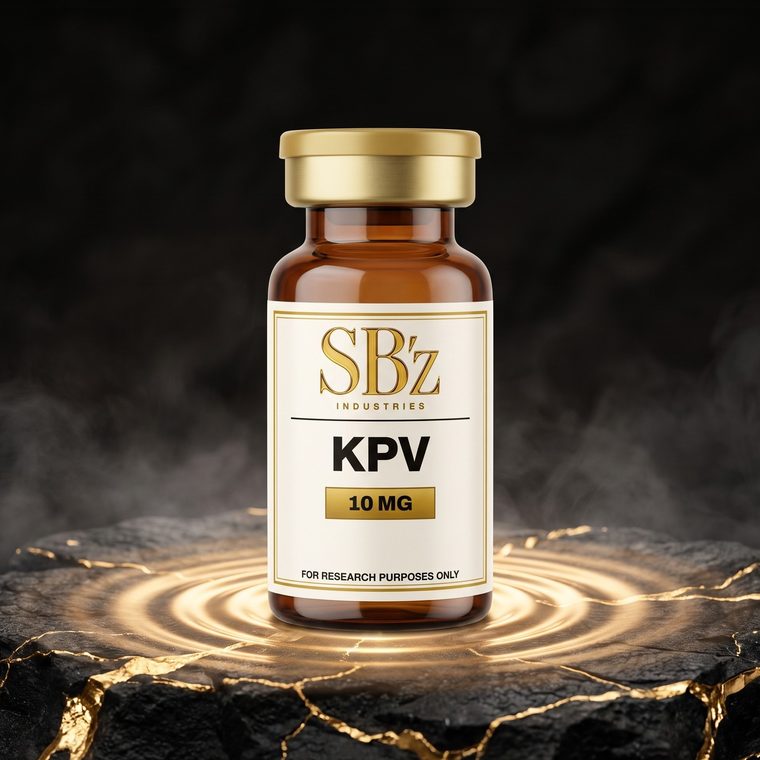
KPV vial
$40per vial

Identity

What KPV is

KPV is a tiny three-amino-acid chain, lysine, proline, and valine, that's actually the tail end of a much longer natural hormone, alpha-MSH. Researchers found that this small fragment alone can reproduce some of the parent hormone's calming effect on immune signaling, without needing the rest of the molecule. It has mostly been studied as a research tool for understanding how immune signaling works at the cell level, first in gut tissue and later in skin cells.

KPV is a synthetic tripeptide of 3 amino acid residues. SBz Industries sells it for laboratory research.

CAS number
67247-12-5
Amino acid sequence
Lys-Pro-Val
Residue count
3
Compound class
Synthetic tripeptide
Appearance
White lyophilized powder
Solubility
Soluble in bacteriostatic water
Storage
Lyophilized: -20C, protected from light. Reconstituted: 2-8C.
Available sizes
10 mg

Research

What the research has looked at

In plain terms, with a link to every study. The most useful thing to notice is what each study was done in.

KPV's best-known study is a 2008 paper out of Emory University that tested it in mice with chemically irritated colons, tracing how the peptide gets into cells and what it does once inside. A separate paper looked at how KPV signals inside human skin cells growing in a dish. Both studies are more about mechanism than about outcomes in whole, healthy people.

mice2008

Mice with two different types of chemically induced colon irritation were given KPV in their drinking water; researchers tracked how the peptide entered cells through a specific transporter protein and measured tissue damage and immune signaling molecule levels, finding both were lower in the treated mice.

PepT1-mediated tripeptide KPV uptake reduces intestinal inflammation.
Dalmasso and colleagues, Gastroenterology

Each study links to its record on PubMed, the US National Library of Medicine database. Checked 25 September 2026.

Handling

Mixing and storage

Lyophilized: -20C, protected from light. Reconstituted: 2-8C.

Full handling guide
  1. 01

    Let it warm up

    Give the vial twenty minutes on the bench before opening it, so water does not condense onto the powder.

  2. 02

    Add bacteriostatic water

    Slowly, down the inside wall of the vial, never straight onto the powder.

  3. 03

    Let it dissolve

    Leave it alone until it clears. Do not shake it. Shaking damages the peptide.

  4. 04

    Refrigerate and use

    Once mixed, it breaks down much faster than the dry powder. Keep it cold and dark.

Documentation

Tested before it goes on sale

An independent lab tests every compound we sell. It confirms the compound is what the label says and measures purity by HPLC.

The latest certificate is on the product page, so you can read the result before you order.

See the certificate

Questions

Common questions about KPV

What is KPV?

KPV is a tiny three-amino-acid chain, lysine, proline, and valine, that's actually the tail end of a much longer natural hormone, alpha-MSH. Researchers found that this small fragment alone can reproduce some of the parent hormone's calming effect on immune signaling, without needing the rest of the molecule. It has mostly been studied as a research tool for understanding how immune signaling works at the cell level, first in gut tissue and later in skin cells. SBz Industries sells it for laboratory research only.

Has KPV been tested in people?

Not in a published human trial found here. The research is in mice and in human cells grown outside the body in a lab dish.

Where does KPV come from?

It is the last three amino acids of alpha-MSH, a longer natural hormone, and researchers found this short piece alone can reproduce part of what the full hormone does.

How is KPV reconstituted?

KPV ships as a freeze-dried powder. Mix it with bacteriostatic water, added slowly down the inside wall of the vial, and let it dissolve without shaking. The researcher decides the working concentration, not us, and we publish no protocols.

How should KPV be stored?

Lyophilized: -20C, protected from light. Reconstituted: 2-8C. Vials ship in plain outer packaging with no product name on the outside.

Is KPV tested, and can I see the results?

Yes. An independent lab tests every compound: it confirms the compound is what the label says and measures purity by HPLC. The latest certificate is on the product page, and you can read it before you order.

Who is permitted to purchase KPV?

Researchers and institutions, 21 or over. By ordering you confirm the material is for laboratory research and will not be used in humans or animals.

Order

KPV, third-party tested

Every compound is third-party tested, with the certificate on its product page. Every order ships in plain packaging.

Fast dispatchShips in 1 to 2 business days
Plain packagingNo exterior branding
Tracked shippingTwo business days, flat rate
Third-party testedCertificate on every product page