Online ordering is open. Ships in 1 to 2 business days. Tracked 2-day shipping, plain box. Every compound third-party tested

For laboratory and research use only. Not for human or veterinary use.

L-Carnitine

Quaternary ammonium compound, sold for laboratory research.

161.20
g/mol
1
size
HPLC
purity, third-party tested
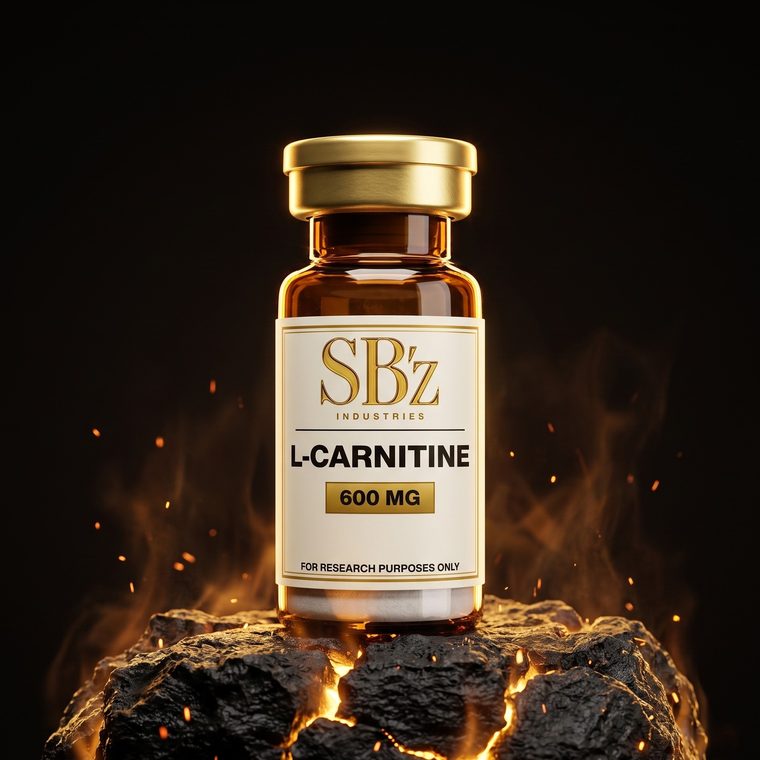
L-Carnitine vial
$45per vial

Identity

What L-Carnitine is

L-Carnitine is a small molecule the body already makes from two amino acids, mostly in the liver and kidneys, and then stores in muscle and heart tissue. It is also sold as a standalone supplement, usually marketed around exercise and weight management. Think of it as a shuttle, its main job is carrying fat into the part of the cell that burns it for fuel.

L-Carnitine is a quaternary ammonium compound, molecular formula C7H15NO3, molecular weight 161.20 g/mol. SBz Industries sells it for laboratory research.

CAS number
541-15-1
Molecular formula
C7H15NO3
Molecular weight
161.20 g/mol
Amino acid sequence
Not applicable
Compound class
Quaternary ammonium compound
Appearance
White crystalline powder or solution
Solubility
Water soluble
Storage
Per supplier spec. Confirm before publishing.
Available sizes
600 mg

Research

What the research has looked at

In plain terms, with a link to every study. The most useful thing to notice is what each study was done in.

L-Carnitine has one of the deeper research records of anything in this catalog, with dozens of randomized trials in people going back over 30 years. Most of that work centers on weight, fasting-related fatigue, and exercise recovery, with mixed and often modest results. Reviews that pool this data describe small average effects, not dramatic ones.

review2021

Reviewed 11 human trials that gave people oral L-carnitine either once before a workout or daily for weeks, then measured things like perceived effort and cycling power. Higher-intensity workout tests tended to show higher power numbers with carnitine; moderate-intensity tests generally showed no difference from placebo.

Effect of Acute and Chronic Oral l-Carnitine Supplementation on Exercise Performance Based on the Exercise Intensity: A Systematic Review.
Mielgo-Ayuso and colleagues, Nutrients

Each study links to its record on PubMed, the US National Library of Medicine database. Checked 25 September 2026.

Handling

Mixing and storage

Per supplier spec. Confirm before publishing.

Full handling guide
  1. 01

    Let it warm up

    Give the vial twenty minutes on the bench before opening it, so water does not condense onto the powder.

  2. 02

    Add bacteriostatic water

    Slowly, down the inside wall of the vial, never straight onto the powder.

  3. 03

    Let it dissolve

    Leave it alone until it clears. Do not shake it. Shaking damages the peptide.

  4. 04

    Refrigerate and use

    Once mixed, it breaks down much faster than the dry powder. Keep it cold and dark.

Documentation

Tested before it goes on sale

An independent lab tests every compound we sell. It confirms the compound is what the label says and measures purity by HPLC.

The latest certificate is on the product page, so you can read the result before you order.

See the certificate

Questions

Common questions about L-Carnitine

What is L-Carnitine?

L-Carnitine is a small molecule the body already makes from two amino acids, mostly in the liver and kidneys, and then stores in muscle and heart tissue. It is also sold as a standalone supplement, usually marketed around exercise and weight management. Think of it as a shuttle, its main job is carrying fat into the part of the cell that burns it for fuel. SBz Industries sells it for laboratory research only.

Does L-carnitine actually help with weight loss?

Pooled data from nine human trials found people taking it lost a small amount more weight than a placebo group, on average a few pounds over the study period, and the gap got smaller the longer people took it.

Is L-carnitine the same thing the body already makes?

Yes. It is the same molecule the liver and kidneys produce from two amino acids; a supplement just adds more of it from outside.

What is the molecular formula and weight of L-Carnitine?

The molecular formula is C7H15NO3. The molecular weight is 161.20 g/mol. Both are stated on the certificate of analysis on the product page.

How is L-Carnitine reconstituted?

L-Carnitine ships as a freeze-dried powder. Mix it with bacteriostatic water, added slowly down the inside wall of the vial, and let it dissolve without shaking. The researcher decides the working concentration, not us, and we publish no protocols.

How should L-Carnitine be stored?

Per supplier spec. Confirm before publishing. Vials ship in plain outer packaging with no product name on the outside.

Is L-Carnitine tested, and can I see the results?

Yes. An independent lab tests every compound: it confirms the compound is what the label says and measures purity by HPLC. The latest certificate is on the product page, and you can read it before you order.

Who is permitted to purchase L-Carnitine?

Researchers and institutions, 21 or over. By ordering you confirm the material is for laboratory research and will not be used in humans or animals.

Order

L-Carnitine, third-party tested

Every compound is third-party tested, with the certificate on its product page. Every order ships in plain packaging.

Fast dispatchShips in 1 to 2 business days
Plain packagingNo exterior branding
Tracked shippingTwo business days, flat rate
Third-party testedCertificate on every product page