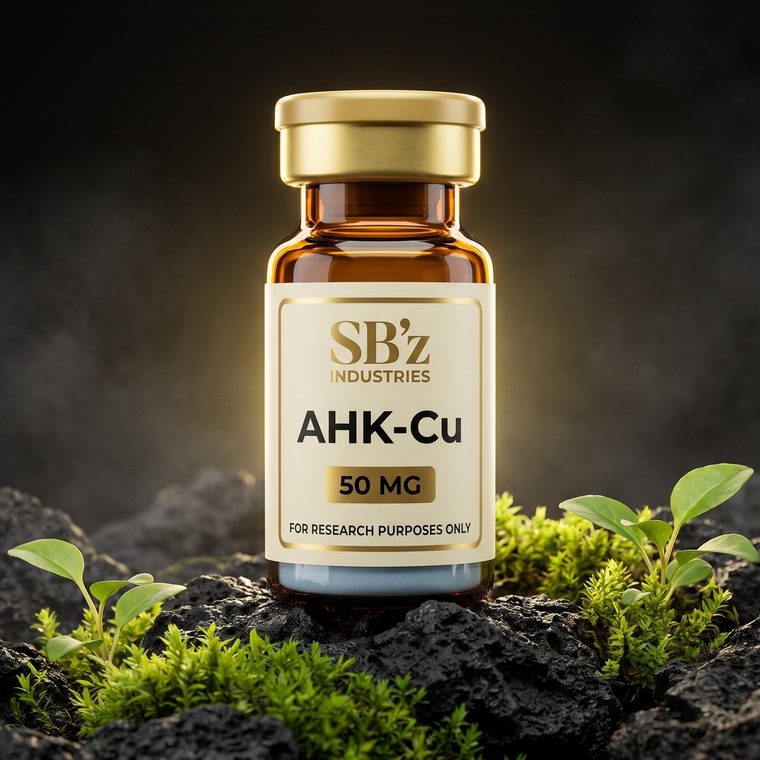
What is AHK-Cu?
AHK-Cu is short for a tiny three-link chain of amino acids, alanine, histidine, and lysine, wrapped around a copper ion the way a small claw holds a marble. It belongs to the same general family as GHK-Cu, a much better known copper tripeptide, but swaps one amino acid link and pairs it with a different overall sequence. Copper is the reason peptide-copper complexes like this one are often described as blue or blue-green in solution. SBz Industries sells it for laboratory research only.
Is AHK-Cu the same as GHK-Cu?
No. Both are copper-binding tripeptides sharing a histidine-lysine backbone, but GHK-Cu starts with glycine while AHK-Cu starts with alanine. They're structurally similar cousins, not the same molecule, and most well-known copper-peptide research is actually on GHK-Cu.
Has AHK-Cu been tested in people?
No published human study turned up. The one identifiable study used donated human skin tissue and cells grown in a lab, not a living volunteer.
How is AHK-Cu reconstituted?
AHK-Cu ships as a freeze-dried powder. Mix it with bacteriostatic water, added slowly down the inside wall of the vial, and let it dissolve without shaking. The researcher decides the working concentration, not us, and we publish no protocols.
How should AHK-Cu be stored?
Store as stated on the product page and the certificate of analysis. Vials ship in plain outer packaging with no product name on the outside.
Is AHK-Cu tested, and can I see the results?
Yes. An independent lab tests every compound: it confirms the compound is what the label says and measures purity by HPLC. The latest certificate is on the product page, and you can read it before you order.
Who is permitted to purchase AHK-Cu?
Researchers and institutions, 21 or over. By ordering you confirm the material is for laboratory research and will not be used in humans or animals.